Eric the Blue

Mostly politics, sports, literature, arts reviews

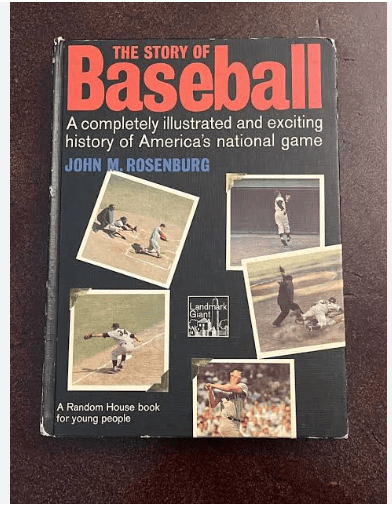
  • When I was a little kid, my parents gave me for a gift The Story of Baseball, “a Random House book for young people” by a guy named Rosenburg. It looked like the above, which I just found in an ebay ad: apparently, if I still had the book, I might be able to sell it for around fifty bucks. Or maybe not, because the pages of mine were worn and smudged, and anyway I’d want to keep it. I thought of one of the book’s chapters today, on the Daffy Dodgers, a name applied to the Brooklyn team of the late 1920s, when their inept play, in the field and especially running the bases, made them a fixture in the second division of the National League. In one incident described by Rosenburg, a Dodger, batting with a runner on first and less than two outs, drove a ball deep into the outfield and, thinking he for sure had a double, charged around first base and sprinted toward second with his head down. But the base runner, after advancing most of the way to second, saw that the ball might get caught, so he retreated toward first. The two runners crossed each other between first and second bases while headed in opposite directions.

    In the Twins game today, something too much like that happened in the ninth inning. With the Twins trailing 6 to 2, our first two batters, Josh Bell and Victor Caratini, reached safely and were occupying first and second bases when the next batter, Brooks Lee, hit a ball into the right center field alley. Of course the camera follows the ball, so you could see the center fielder make a diving effort to catch it, which failed. When the ball was quickly recovered and thrown into the infield, both Caratini and Lee were near second base, and Bell was near third. It seems that Lee, imitating the Daffy Dodger of old, had put his head down and run to second base.. Meanwhile, Caratini, seeing that the outfielder might catch the ball, had stopped near second to see whether he might have to head back to first. Lee ran right up to him. I think that when the ball wasn’t caught, Bell first thought that Caratini would solve the crowding problem near second base by trying to advance to third, so he rounded third and started home. But then he saw Lee head back toward first, so he tried to duck back into third, but was tagged out when the outfielder’s throw was relayed to the third baseman. Then the third baseman threw across the diamond and Lee was tagged out, too. Instead of the bases loaded and no outs, there were two outs, a runner on second, and the same old 6 to 2 score. The next batter struck out to end the game.

    As a teenager, I had a summer job coaching tee-ballers, and I distinctly remember one game in which the batter dribbled the ball toward first base. The first baseman charged in, fielded the ball, and was going to tag the batter as he ran past him on the way to first base. But the kid who had hit the dribbler just stopped, and he and the first baseman contemplated each other for a second or two. Then, instead of going back to tag first base for the out, the addled first baseman ran toward the kid who’d hit the ball. The play ended as the runner retreated toward home and the first baseman threw to the catcher, who tagged the boy who’d hit the ball as he slid into home from the first base line. This was around 10 o’clock on a weekday morning in the summer of, I think, 1975, and the moms watching the game loved it. You have to pay good money to see that kind of stuff in the Big Leagues.

  • Will Rogers famously remarked that he did not belong to an organized political party–he was a Democrat. I thought of that yesterday after Trump endorsed clownish Pillow Guy for governor of Minnesota. The chairman of the state GOP responded by putting out the following statement:

    We were surprised by President Trump’s endorsement of Mike Lindell. We strongly support the President and his agenda, but Minnesota Republicans must choose the candidate best positioned to defeat Amy Klobuchar.

    When the going got tough under Tim Walz, Mike Lindell left Minnesota for Texas. Now he wants Minnesota Republicans to overlook his serious financial baggage, public records showing tens of thousands of dollars in delinquent property taxes, significant electability concerns, and unanswered questions surrounding his running mate. Minnesota cannot afford to nominate a ticket that gives Democrats an easy target and creates the very real possibility of another DFL trifecta.

    Other Republican candidates have spent years strengthening our party, supporting candidates, raising resources, and doing the hard work required to win elections.

    Republican delegates considered Mike Lindell at the State Convention, and he finished third. We believe that is where he will finish in the August primary.

    These are serious times, and they require serious, disciplined leadership. Minnesota needs a governor who can unite Republicans, earn the support of independent voters, and defeat Amy Klobuchar.

    That’s a lot of words from the state party chair without mentioning the name of the party’s endorsed candidate! Embarrassed of Pillow Guy, and less than proud of the guy selected by the delegates. That leaves the candidate Joe Soucheray spoke with recently:

    Only outsiders are allowed to say that the emperor is obviously naked. Why is the state chair “surprised” that Trump endorsed clownish Pillow Guy? Clownish Pillow Guy is the biggest Trump sycophant in the group, therefore . . .

    The most notable aspect of the chairman’s communication is its barely suppressed undertone of desperation. The desperation arises from the rule against spitting out poison. Pillow Guy has swallowed it and begged for more, thereby earning the president’s endorsement. Soucheray’s guest opts for swishing it around in her mouth for an indeterminate period. I don’t know what to say about the candidate selected by the Republican party’s activists. It might be the only thing I have in common with the party’s state chairman.

  • Had the kids in stitches at the supper table tonight. Would likely be pleased with myself if I’d been trying to be funny.

  • Got a little misty-eyed watching Dick Bremer get a little misty-eyed while being inducted into the Twins’ Hall of Fame this afternoon. They’re playing now, and the telecast just cut to Bert Blyleven, his ceremonial duties discharged, enjoying the game with a Coors Lite cracked open in front of him: everything’s coming back into focus. My free-associating mind settles on the one-sided game from years ago when Dick and Bert began assembling, on-air, an all body parts team. They had Bill Hand, Rollie Fingers, maybe a couple others and then, after several seconds of dead air, Bert said, “Not sure this is a good idea, Richard.”

    Seeing all those old-time Twins made me curious about some statistical tidbit from the past and, in the course of looking it up, I was impressed at how Killebrew dominates all-time team statistical leaders in batting categories. He’s at the top of the list for

    • homers
    • RBIs
    • runs
    • total bases
    • extra base hits
    • slugging percentage
    • OPS

    You could say that it all flows from the homers–he hit 559, almost twice as many as Kent Hrbek, who’s in second place with 296. An extra 260-some homers gives Harmon a big head start in all those other categories.

    Well sure, that’s fair: homers win games. I should say that, with respect to winning and newfangled statistical calculations, Killebrew is second in WAR (“wins above replacement”), just behind Rod Carew and just ahead of Joe Mauer and Kirby Puckett. No real surprises at the top of that list. I think I’ve mentioned before that I anyway am surprised by Byron Buxton’s place among all-time slugging percentage leaders:

    Killebrew .514
    Buxton .495
    Morneau .485
    Sano .482
    Hrbek .481

    Taking account of his fielding and base running, Buck would be in the mix for greatest Twin ever if it weren’t for the injuries that have kept him off the field.

  • I edited a joke and texted it to my sister, a retired chemistry professor. Slow day, needed a brightener, and figured she’d deliver.

    Yes, it developed that the dots, blinking in real time, were an alert: rant gestating. But you can get enough of those from her brother.

  • Since writing this, I by chance saw the above episode of Firing Line, in which the legal scholar Melissa Murray, though without mentioning what Tennessee’s state legislature did to the people of Memphis, says pretty much what I said about the Supreme Court’s decision in the case called Callais. There’s at least two of us!

    I thought the last part of the interview, concerning the difficulty of amending the Constitution, was even more interesting. Twenty-seven amendments might sound like a goodly number, but, as Murray points out, ten of them (the Bill of Rights) were adopted in 1791, leaving just 17 more to be enacted over the last 235 years. She might have added that one of those 17 was Prohibition, which was subsequently rescinded by another amendment, with the result that, discounting contretemps over whether an American can have a drink, there have been 15 amendments in 235 years, including just one in the last 55.

    For those of worshipful inclinations, that’s just fine: you don’t edit the Ten Commandments or the U.S. Constitution, as the former came from God and the latter from guys whose portraits are on our money. Yet the Constitution allows for itself to be amended, has been amended, and, when you consider the contents of some of those amendments–I mentioned Prohibition (and its repeal)–you feel as if possibly even weightier matters have been overlooked. It comes up in the interview that Murray participated in an exercise whereby scholars from different segments of the ideological spectrum convened to try to come up with some needed amendments. I take it that there was at least majority support for

    • amending the Constitution to make it easier to amend the Constitution
    • making it harder for the House to adopt articles of impeachment but
    • in the event said articles get adopted, lowering the bar for conviction in the Senate
    • resurrecting the legislative veto
    • scrapping the requirement that the president be a natural born citizen
    • instituting term limits (18 years) for Supreme Court justices
    • abolishing the electoral college and providing for direct popular election of the president

    I’d be happy with all those. The most obvious missing item, in my view, is reform of the Senate. That every state gets two senators has resulted in grotesque imbalances in representation that the founders could not have foreseen and would not have condoned. The combined populations of Idaho, Montana, Wyoming, North Dakota, South Dakota, and Nebraska come to about 7.5 million people. The population of Los Angeles County, in California, is about 9.7 million. So 7.5 million people are represented by 12 senators, while 9.7 million of their fellow citizens share two senators with 30 million other Californians. I said the founders could not have foreseen such an arrangement and wouldn’t have approved, which I think is true–mainly because some of them, preeminently Alexander Hamilton, did not approve of the much milder imbalances that obtained in the founding era. See, for example, Federalist No. 22, where Hamilton wrote:

    Every idea of proportion and every rule of fair representation conspire to condemn a principle, which gives to Rhode Island an equal weight in the scale of power with Massachusetts, or Connecticut, or New York; and to Delaware an equal voice in the national deliberations with Pennsylvania, or Virginia, or North Carolina. Its operation contradicts the fundamental maxim of republican government, which requires that the sense of the majority should prevail . . . .

    The public business must, in some way or other, go forward. If a pertinacious minority can control the opinion of a majority, respecting the best way of conducting it, the majority, in order that something may be done, must conform to the views of the minority; and thus the sense of the smaller number will overrule that of the greater, and give a tone to the national proceedings. Hence, tedious delays, continual negotiation and intrigue, contemptible compromises of the public good.

    A dozen more such passages, on a handful of other topics, from a few additional representatives of the founding generation, and I’d consider withdrawing my skepticism of their supposed omniscience.

  • I understand Taylor and Travis are hitched. I have an online subscription to the NYT and can tell you: that organ of journalism is on the case. I’m the better for it, as I now know that Cornelia Street is in Greenwich Village, not London, as for some reason I had supposed. Maybe it’s because on the Lover album “Cornelia Street” is separated from “London Boy” only by “Death from a Thousand Cuts,” so I’ve heard those songs together on the same short car trips when traveling with my roommates. Through osmosis, I know a fair amount about TS, and, like a lot of people less than half my age, feel a connection with her. In my case, it’s largely on account of the lyrical opening to one of her . . . I think the kids say “bangers”?

    The moon is high
    Like your friends were on the night that we first met
    Went home and tried to stalk you on the internet
    Now I've read all the books beside your bed

    She’s way too rich and famous to qualify as a dweeb, but a worldview that includes the notion that reading the books that a love interest likes is a good way to get to know them? Whoa! She was meant for me, not a football player. Will sign the prenup.

    Here’s the music video of said banger, “Paper Rings”:

    According to the refrain, she likes shiny things, but would marry him with paper rings–another case of life not imitating art, assuming the Times’s coverage to be moderately accurate.

  • According to this New York Times article, an American family of four–dad, mom, two kids under age 8–cannot keep above water with a household income of $130,000. In 2024 they had a small cushion that has now trickled away. I was a little skeptical–for example, I don’t doubt that the claim would hold in Manhattan, but how about in Manhattan, Kansas? It also seems like the lack of line-item expenses in the article is a weakness, but of course one can try and do that on one’s own, and now that I’ve done it my skepticism is leaking. In what follows, I’m tweaking my own numbers to make them perhaps more “normie,” and in cases where I have no idea what’s normal (which is most of them), I’ve accepted the calculations of AI for questions typed into Google, such as “Average grocery bill for family of four.” Here we go:

    Housing (mortgage, homeowner’s insurance, and property taxes): $26,000

    Childcare for the kids, one of whom is assumed to be in elementary school, the other a full-timer at the day care: $25,000

    Health insurance: $23,000 (source for this estimate is KFF’s Health Insurance Marketplace Calculator)

    Groceries: $17,000

    Own and operate two cars: $22,000

    Federal income tax: $7500

    Okay, so now they have less than $10,000 left, and no one has been to the dentist or gotten a new pair of shoes (or clothes of any kind). Nothing for a plumber, either. Nothing for state taxes. Save for college or retirement? LOL!

    It’s no wonder that opinion surveys detect a sour mood in the land. I suspect $130,000 was chosen because it’s the nearest figure divisible by 10,000 that’s above the median household income for a family of four, which means more than half the families earn less than that.* I recently stumbled upon an essay in which a conservative intellectual was wringing his hands over the high percentage of young Americans who express a favorable view of socialism. I’m not sure what the definition of “socialism” is–almost certainly includes any effort by the government to help people to afford health insurance and day care. If he thinks they shouldn’t have to pay $7500 more in taxes than Elon Musk, that’s something we could agree about. Meanwhile, the president won’t stop blathering about the golden ballroom he’s building on the White House grounds.

    *At the school where I work there’s a teacher who I’d be elated to learn was going to have my kid in her class next year–she’s really, really good at her vital job. Since I’ve always worked in the public sector, I know you can find online the salary of any public employee in Minnesota, so I looked her up: $46,000. She’s young, and if she stays at it, gets her master’s degree, marries a colleague, and has two kids, the above financial scenario would likely be a pretty close fit.

  • Sometimes, when Trump shits the bed, it’s kinda fun to switch over to Fox News to see who’s pinch-hitting for the befouled king, maybe a humanities professor at a small liberal arts college “near San Francisco” with unusual views about . . . something. Today, the leader of the free world went on an unhinged social media rant about a golf course he wants to build in D.C., with a detour into the plague of algae at the mall’s reflecting pool, which he’s still blaming on Far Left Vandals armed with mysterious powers that include, it seems, expertise in biological engineering –the algae, he now says, is “criminally made.” I’m sure the people put off by the attention he’s devoting to algae mitigation and the construction of his golden ballroom will be happy to hear a golf course is in the works, too.

    The Twins and their shaky bullpen were nursing a 1-run lead in the late innings, so I did not switch over to Fox. I did bring up on my phone the URL of the Power Line blog, to see what’s newsworthy in the world according to the authors of that unintentionally amusing site. Not, predictably, their president’s heated preoccupation with ephemera, but, somewhat to my surprise, since it raises the issue of climate change, the heat wave in Europe. The author, John Hinderaker, quotes approvingly a fellow winger who says temperatures of 36 degrees Celsius in the UK mean it’s time to drill for more oil in the North Sea, before proceeding:

    I wondered: how hot is 36 degrees C? I was surprised to see that it is only 96.8 degrees Fahrenheit. That is hot, to be sure. But where I live, in the northern US, not the southern, that is a pretty common temperature in the summer. In fact, the forecast for Monday where I live in Minnesota is a high of 98 degrees. When I was a kid growing up in South Dakota, summer temperatures in the 90s were common, and occasionally the thermometer soared over 100 . . . .

    Not sure what point he’s trying to make, but I also live in the northern US–which, as Hinderaker helpfully points out, is not the southern US–and, since his description of the local weather seemed to me a little off, I can now report that, going back to 1891, there have been more than 60 years in which the single hottest day in Minneapolis had a high temperature of 96 degrees F or less. So I don’t think it’s accurate, strictly speaking, to say that 96.8 degrees “is a pretty common temperature in the summer” where Hinderaker lives, in a suburb of the Twin Cities: in almost half the years, there’s not a single day it’s been that hot. According to the Internet, Hinderaker was born in 1950 and grew up in Watertown, SD, so I’ve checked out the hottest day of the year in Watertown, 1956 to 1968, which I’m guessing coincide with the years he attended school there. In 9 of those 13 years, the hottest day was less than 100 degrees F. Maybe he should have said that “very occasionally the temperature soared over 100, [and those handful of days made a strong impression on me.]”

    I guess his point is that it’s always been hot in the summer and therefore it’s no surprise, and certainly not evidence of climate change, if it’s hot in Europe late in June. But in that case what to make of the half-cocked geography lesson with which his column begins:

    Sometimes it gets hot. Even in Northern Europe, currently in the midst of a heat wave. Many people don’t realize that London is farther north than anywhere in the contiguous U.S. It is at the same latitude as Calgary, Canada. Paris is at the same latitude as North Dakota and Montreal. So Northern Europe has not generally been home to high temperatures.

    If Northern Europe has not generally been home to high temperatures, and now it is, maybe that’s a sign that human activity is causing the climate to change? The paragraph is odd in other ways. It’s true that Calgary and London are at the same latitude, but it’s weird to say that a city (Paris) is at the same latitude as a state (North Dakota) that’s more than 200 miles in its north-south dimension, corresponding to more than 3 degrees of latitude. Since Paris is at 48.86 degrees north latitude, and the 49th parallel is the border between North Dakota and Canada, virtually all of North Dakota is south of Paris. Paris is also considerably farther north than Montreal, which is at 45.5 degrees north latitude. It’s almost as if Hinderaker doesn’t know what he’s talking about.

  • In his poem “The Great Society”–title refers to President Johnson’s domestic program–the American (rural Minnesota, born and bred) poet Robert Bly begins with dentists who “continue to water their lawns even in the rain” before proceeding to hands that, having been “developed with terrible labor by apes,” now “hang from the sleeves of evangelists.” Later, we are told that “[t]he president dreams of invading Cuba.”

    I’ve been thinking that, were the poem to be updated for MAGA times, the Secretary of War would be blowing up little fishing boats in the Caribbean while the president pores over blueprints for his ballroom. The updated poem would have to be longer than a sonnet if we wanted to allude also to the MMA fights on the White House lawn, the algae in the reflecting pool over which Lincoln gazes sternly, and the brilliant planning for the Iran war from which it appears we will be extricated by folding like a poor man holding a pair of nines.

    You know, without evidence, that the corpses in those fishing boats were “narco-terrorists” because the guys who can’t get the algae out, or lay a plan for what to do if Iran closes the Strait, could not possibly be confused about three things. I’m leaving out all the dead elementary school children. Details!

    The bit about the president dreaming of invading Cuba could stand.