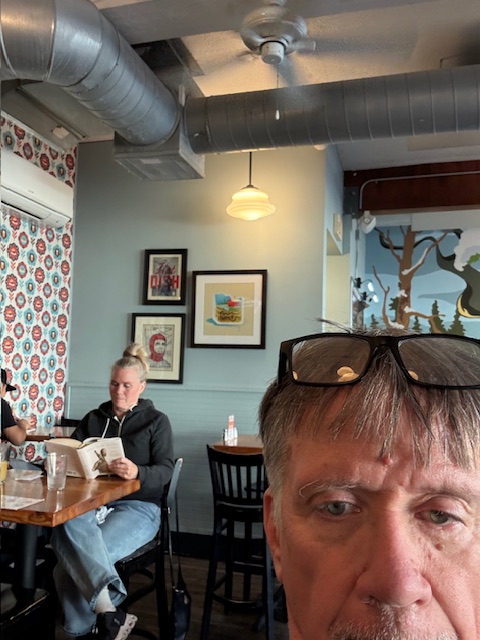
Last Sunday, beautiful day in Minneapolis, I ran out of leaf bags and so made the 15-minute walk to the Ace Hardware at 38th & Nicollet. On the way home, old joints aching, I decided I was enough of a Vikings fan to pop in to the LowBrow, at 43rd, where I nursed two Hamms through most of the game’s second half. I took the above pic over my shoulder of a woman reading her library book in the bar.
Personally, I read mainly in bed, never in bars: currently, Selected Writings of Samuel Johnson, the same volume that includes Rasselas, which I recently mentioned. Now I’m on “Milton,” from Lives of the Poets. I’m jumping around in the tome and chose “Milton” because I knew that, after wading through the lavish praise, I’d come to Johnson’s quotable reservations about Paradise Lost:
The plan of Paradise Lost has this inconvenience, that it comprises neither human actions nor human manners . . . . The want of human interest is everywhere felt. Paradise Lost is one of those books which the reader admires and lays down, and forgets to take up again. None ever wished it longer than it is.
In other words, a colossal bore. I do not recall my 19-year-old self admiring anything through the soporific gauze. I had forgotten that Johnson is even harsher on the subject of Milton’s Lycidas, the high reputation of which I can illustrate with an anecdote. The American poet Robert Lowell had mental health challenges that required intermittent hospitalizations. Once, when some of his poet friends visited him in the psych ward, they had to listen to Lowell expostulate on the new, “improved” version of Lycidas that he was working on between therapy sessions. His friends regarded this as irrefutable proof that he was indeed out of his mind. Following Johnson, I’d say Lycidas could be improved simply by omitting the learned references to obscure mythological tales by the supposedly grieving speaker. Sad, but not too sad to show off his learning. It’s instructive to set, one after the other, the following from “Milton”–
[H]e knew human nature only in the gross, and had never studied the shades of character . . . . He had read much and knew what books could teach; but had mingled little in the world and was deficient in the knowledge which experience must confer.
–with Johnson’s famous assessment of Shakespeare’s powers:
This therefore is the praise of Shakespeare, that his drama is the mirror of life; that he who has mazed his imagination, in following the phantoms which other writers raise up before him, may here be cured of his delirious ecstasies, by reading human sentiments in human language; by scenes from which a hermit may estimate the transactions of the world, and a confessor predict the progress of the passions.
At least in the portion reprinted in this selection of his writing, Johnson’s “Milton” is a lot of literary criticism, hardly any biography, but it does include one biographical detail that, unlike the criticism of Lycidas, I will forget only with an assist from advanced dementia:
When he did not care to rise early, he had something read to him by his bedside; perhaps at this time his daughters were employed. He composed much in the evening, and dictated in the day, sitting obliquely in an elbow-chair, with his leg thrown over the arm.
Striking mainly because one would never otherwise imagine Milton lounging comfortably. It also reminds detractors like me of his blindness and the indisputably heroic aspects of his life, which divides easily into three periods: youthful apprenticeship culminating in Lycidas; participant in political controversies and pamphleteer in support of liberal causes, such as press freedom and divorce reform; and last, after the Stuart Restoration in 1660, when he was in his early 50s, political disappointment, blindness, and authorship of the poetic epics for which he’s famous, dictated to various secretaries.
It’s also attractive, at least to me, that in Johnson’s telling Milton, a man of vast learning and intellectual sophistication, was almost wholly indifferent to money and thus an easy mark. Johnson’s brief narration of this side to the author of Paradise Lost concludes with a kind of dead fall:
There is yet no reason to believe that he was ever reduced to indigence. His wants, being few, were completely supplied. He sold his library before his death, and left his family fifteen hundred pounds, on which his widow laid hold, and only gave one hundred to each of his daughters.
Should probably be noted that Milton was married three times, was divorced from the first one, survived the second one, and that the third, who survived him, was not the mother of any of his three surviving children, all daughters.


Leave a Reply