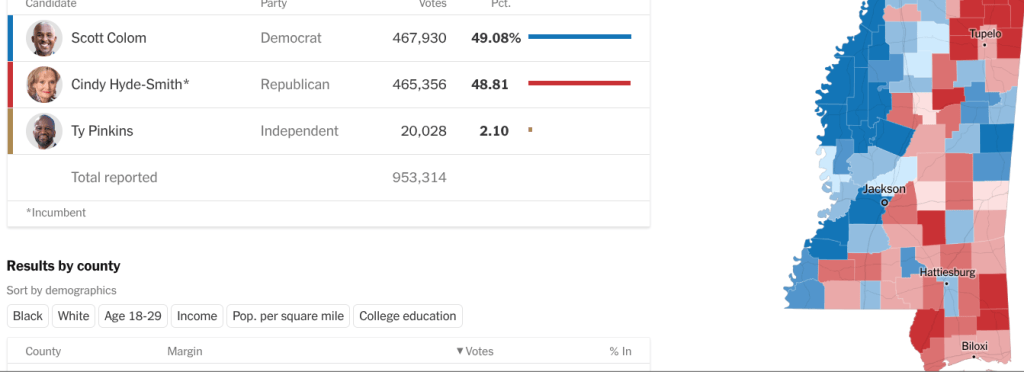
Occasionally, by which I mean hardly ever, the careening strobe light of national media attention shines upon one of my highly idiosyncratic interests, with the result that I feel obliged to talk it up. So it is with the Mississippi Senate election, which I previewed here. I’d like to say “I called it,” but honestly, if my life or even twenty dollars had been riding on it, I would not have dared to say the Democrat, Scott Colom, would win. I thought he would, in a verb favored by commentating savants, overperform, which would not have distinguished him from Democratic Senate candidates in Florida and Louisiana, who both lost by around 2 percent. But win? In Mississippi?
I checked the race about the time I was thinking of turning in on Tuesday evening. The Republican incumbent, Cindy Hyde-Smith, was ahead by 49 to 47 percent, more than half the vote was tabulated, and the New York Times’s election needle gave her a 66 percent chance of winning. Then I really was going to go to bed, so I checked my phone one last time, saw that more votes had been tabulated but that the percentage difference was unchanged, and that the needle now gave Hyde-Smith an 80 percent chance of winning. I then discovered some dirty dishes in the kitchen, washed them, dried them, climbed the stairs to bed, and, after brushing my teeth, checked my phone a third last time. The order of my perceptions was: (1) for some reason, the Times’s website is now showing decimals instead of whole numbers; (2) wow! the difference is only 0.01 percent; (3) wow, wow, it’s the Democrat, Colom, who’s ahead by a hundredth of one percent; (4) the raw vote difference is exactly 21 ballots, out of nearly a million cast (which I’m pretty sure is considerably less than 0.01%); (5) the needle now gives Hyde-Smith only a 55% chance of winning; and (6) the middle of the range of likeliest outcomes is pegged at Hyde-Smith by 0.02 percent.
When I got up in the morning, the needle had been turned off, and Colom’s lead had grown to 43 votes. You could say that it had “more than doubled” but it would probably be more apt to say the race was still tied, especially considering that there were thought to be at least 10,000 uncounted ballots. As a scattering of votes has in subsequent days been added to the tally, Colum’s lead has inched upward, until now–Friday night, just after the conclusion of the Timberwolves’ win over the Pelicans– it stands at 2574 votes.
Some unconnected observations about the race:
Though it’s hard to believe, Mississippi law does not provide for recounts in close elections. It seems that the result is going to be determined by the outcome of the current, ongoing count.
I noted that, as of late Tuesday night, media reports indicated there were at least 10,000 ballots yet to be counted. From what I can make out, these are of two different kinds. One is “stragglers” from the election night tabulation, and the other is what are often called “provisional ballots,” though in Mississippi I guess they call them “affidavit ballots.” Affidavit ballots occur, most commonly, when there is some question about the voter’s eligibility. For example, in Mississippi, you have to show a photo ID to vote, and sometimes the address shown on your ID doesn’t match the one on voter rolls. You are then allowed to vote, but your ballot isn’t counted unless and until there is later some resolution of the discrepancy.
The lead Colom has built over the last few days is from the “stragglers.” A few scattered precincts had not yet reported their results, and Mississippi law also allows mailed ballots that arrive after election day to be counted if they were postmarked on or before election day. These kinds of votes have favored Colom but are now essentially exhausted. The so-called affidavit ballots are looming as a higher and higher percentage of the remaining vote. Little attention is usually paid to them, because it’s rare that the count is close enough for their disposition to matter. But the general tendency, not just in Mississippi, is for these ballots to trend Democratic. Young people, for example, are more likely to move around and have no settled residential address–probably the most common precipitating reason for a provisional ballot. According to The Times, Colom carried Mississippians under age 30 by 62 to 33 percent.
One piece of evidence supporting the above analysis concerns the relative chattiness of the respective candidates. So far as I know, Hyde-Smith has not been heard from since she basically declared victory on Tuesday night. Colom is out doing interviews, urging that the law be followed and every legal vote counted, and wondering aloud why Hyde-Smith, the current senator, has nothing to say about the biggest thing happening in Mississippi. It’s easy to sound high-minded when you’re going to win. If Hyde-Smith is still hoping to win, it’s hard for her to know what to say. Late Tuesday, it appeared that throwing out as many affidavit ballots as possible was her best hope. Now, though, she’s behind by 2500 and so needs more votes to be counted. But the known outstanding votes likely favor Colom. And so the silence.
I have a low opinion of Hyde-Smith and am big enough to admit that I’m enjoying her evident misery. As a kid in Mississippi, she attended one of the many private schools, widely referred to as “segregation academies,” established to make a kind of end run around court ordered racial integration of public schools. Okay, she was a kid, you say, don’t blame her for having parents who didn’t want her attending an integrated school–but then she grew up, became a parent herself, and sent her kids to a segregation academy. As a senator, she’s a cipher: no sign of mental activity but vote after vote for the MAGA agenda.
For those of us ill disposed toward Hyde-Smith, there is one delicious bit of irony connected to her election fight with Colom. Biden nominated Colom, who is a highly regarded district attorney in Mississippi, for a federal judgeship, but Hyde-Smith, as a senator from his home state, made use of the blue-slip tradition to kill the nomination. She said Colom was too liberal, too woke. Of course, he wouldn’t have been running against her for a seat in the Senate if he’d landed on the federal bench. I said that Hyde-Smith “basically” declared victory on Tuesday night–her exact words, spoken to her supporters, were: “I blocked Scott Colom from being a federal judge and tonight you’ve blocked him from being a US Senator.” When Colom was asked to comment on this incident the other day, he laughed, paused for effect, then uttered the ultimate southern brush off: “Bless her heart.”
Hyde-Smith knew what she was doing when she invoked wokeness to explain her opposition to Colom’s nomination to the federal judiciary. Mississippi is definitely not woke. One of its bigger counties, Forrest County, home to the city of Hattiesburg, honors Bedford Forrest, a confederate general and the first Grand Wizard of the Ku Klux Klan. When two years ago Trump won Mississippi in a rout, he carried Forrest County by 19 points. Colom, who is black, defeated Hyde-Smith in Forrest County by 54 to 43 percent, a 30-point swing.


Leave a Reply