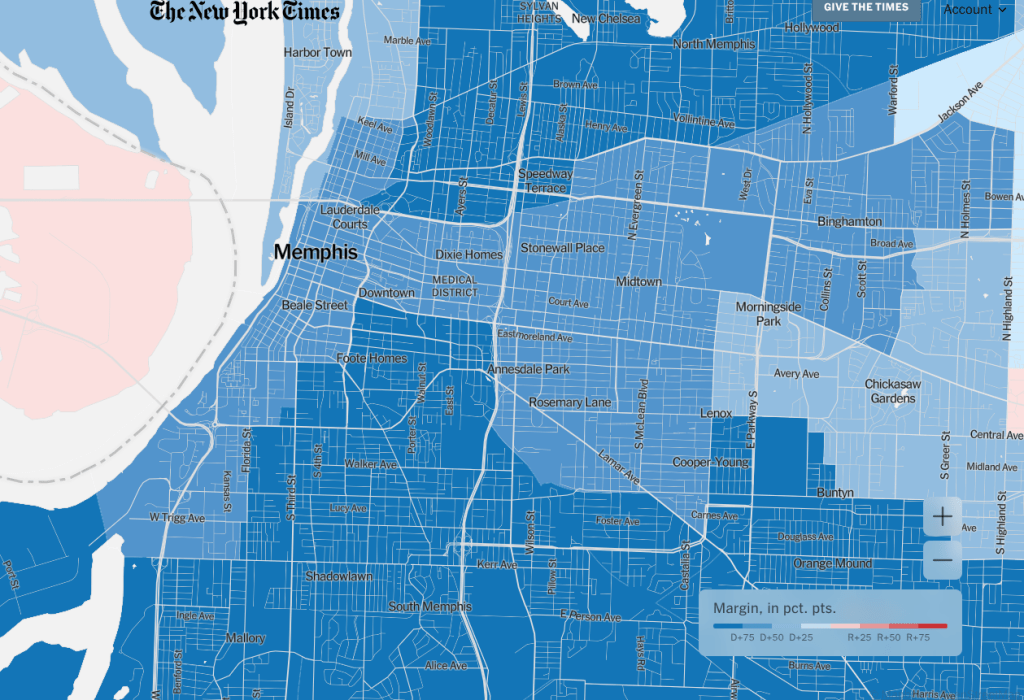
The above is taken from the New York Times’s “An Extremely Detailed Map of the 2024 Election” and shows the outcome, at the precinct level, of the last presidential race in different neighborhoods of Memphis, Tennessee. The white strip with the dashed line is the Mississippi River, which is the border between Tennessee and Arkansas. Downtown Memphis is built up along the east bank of the river. Since it’s hard to make out the legend at the lower right relating to “Margin, in pct. pts.,” I’ll just observe that the darker the blue, the wider Kamala Harris’s margin, and it was pretty wide in the lightest blue parts of the map: for example, she won the area marked Chickasaw Gardens by 69 to 30 percent. To get the darkest shade, by far the biggest area on the map, Harris had to win by at least 75 percentage points: 87 to 13 percent, in other words, would get the second darkest hue.
I got interested in the political landscape of Memphis when, in the wake of the Supreme Court’s recent decision in the Callais case, Tennessee’s state legislature immediately adopted new district boundaries that placed different parts of Memphis within three different congressional districts. The stated purpose was to eliminate the only Tennessee district represented by a Democrat. It’s pretty easy to see why Memphis would have a Democratic representative. The area is so overwhelmingly Democratic that cracking it in two would run the risk of creating two districts in which a Democrat could win. To get all of Memphis into safely Republican districts required cracking it in three.
The question is whether this is legal. If partisan gerrymandering was illegal, then of course congressional maps from sea to shining sea would have to be redrawn. The reason states such as Tennessee had not previously done what they’re now doing relates to the Voting Rights Act, which had been held to prohibit practices that dilute the power of minority voters, especially in southern states with a history of racial discrimination in ballot access. In Memphis, for instance, more than 60 percent of the population is African American, and in Tennessee, in general, whites vote Republican and blacks vote Democratic. So “partisan gerrymandering” that favors Republicans has the practical effect of diluting the political power of African Americans. Actually, “diluting” is too pale a verb. I mean, look at the above map. Once there’s been a congressional election under the new gerrymandered map, who will represent in Washington the views of the people of Memphis, a majority-minority city with a population nearly equal to that of a typical congressional district? No one. Their voice will have been squelched.
The Supreme Court in its Callais decision said no problem, go ahead, and, with the Voting Rights Act neutered, it took Tennessee’s state legislature a New York minute to adopt new maps carving up the city of Memphis. The decision was 6-3, naturally. The court’s conservative majority is like a pulling guard for the Republican party’s end runs. The Chief Justice hates it when people criticize the justices for being political actors. He probably wouldn’t be so sensitive if it weren’t true.
 Eric the Blue
Leave a comment