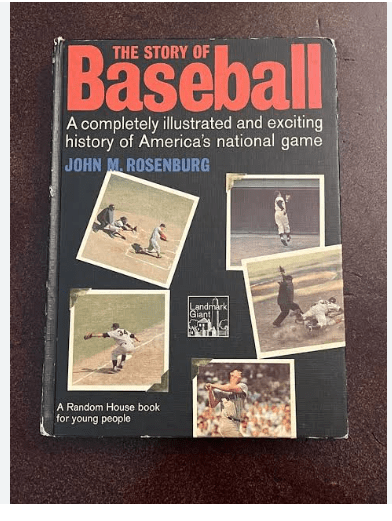
When I was a little kid, my parents gave me for a gift The Story of Baseball, “a Random House book for young people” by a guy named Rosenburg. It looked like the above, which I just found in an ebay ad: apparently, if I still had the book, I might be able to sell it for around fifty bucks. Or maybe not, because the pages of mine were worn and smudged, and anyway I’d want to keep it. I thought of one of the book’s chapters today, on the Daffy Dodgers, a name applied to the Brooklyn team of the late 1920s, when their inept play, in the field and especially running the bases, made them a fixture in the second division of the National League. In one incident described by Rosenburg, a Dodger, batting with a runner on first and less than two outs, drove a ball deep into the outfield and, thinking he for sure had a double, charged around first base and sprinted toward second with his head down. But the base runner, after advancing most of the way to second, saw that the ball might get caught, so he retreated toward first. The two runners crossed each other between first and second bases while headed in opposite directions.
In the Twins game today, something too much like that happened in the ninth inning. With the Twins trailing 6 to 2, our first two batters, Josh Bell and Victor Caratini, reached safely and were occupying first and second bases when the next batter, Brooks Lee, hit a ball into the right center field alley. Of course the camera follows the ball, so you could see the center fielder make a diving effort to catch it, which failed. When the ball was quickly recovered and thrown into the infield, both Caratini and Lee were near second base, and Bell was near third. It seems that Lee, imitating the Daffy Dodger of old, had put his head down and run to second base.. Meanwhile, Caratini, seeing that the outfielder might catch the ball, had stopped near second to see whether he might have to head back to first. Lee ran right up to him. I think that when the ball wasn’t caught, Bell first thought that Caratini would solve the crowding problem near second base by trying to advance to third, so he rounded third and started home. But then he saw Lee head back toward first, so he tried to duck back into third, but was tagged out when the outfielder’s throw was relayed to the third baseman. Then the third baseman threw across the diamond and Lee was tagged out, too. Instead of the bases loaded and no outs, there were two outs, a runner on second, and the same old 6 to 2 score. The next batter struck out to end the game.
As a teenager, I had a summer job coaching tee-ballers, and I distinctly remember one game in which the batter dribbled the ball toward first base. The first baseman charged in, fielded the ball, and was going to tag the batter as he ran past him on the way to first base. But the kid who had hit the dribbler just stopped, and he and the first baseman contemplated each other for a second or two. Then, instead of going back to tag first base for the out, the addled first baseman ran toward the kid who’d hit the ball. The play ended as the runner retreated toward home and the first baseman threw to the catcher, who tagged the boy who’d hit the ball as he slid into home from the first base line. This was around 10 o’clock on a weekday morning in the summer of, I think, 1975, and the moms watching the game loved it. You have to pay good money to see that kind of stuff in the Big Leagues.


Leave a Reply