The term “dummymander” refers to getting hoisted on the petard of your own gerrymander. Here’s the most common way it would occur: a political party redraws district lines in a way that, in exchange for reducing its expected margin of victory in individual districts, increases its expected number of seats won. The plan is confounded when the “reduced expected margin” turns into a surprise victory for the other side.
Lots of Democrats are celebrating the dummymanders that didn’t work out for the Republicans. But how prevalent was it? I’m afraid that the drive to experience more and more Schadenfreude is tempting people on my side to conclude that everything went wrong for Republicans in this election. I suspect that Republican gerrymanders actually worked out pretty well for them, and there’s every reason to believe that if allowed to stand the gerrymanders will benefit them next time, too.
Texas is probably the best laboratory for testing the above proposition. It’s huge, of course, and it also is the state that began this cycle’s redistricting wars when, heeding Trump’s directive, it redrew its congressional districts in a way that was intended to yield five additional Republican seats. Then the election occurred and Democrats swept to power in Texas. The top-line headline that lodges in the brain is that in Texas–Texas!–the Democrats went 8-for-8 in statewide races: US Senator, governor, lieutenant governor, attorney general, comptroller, land commissioner, agricultural commissioner, and railroad commissioner, all won by the Democrat.
But you can’t judge a gerrymander by the result of statewide races. No one diddled with Texas’s outer boundaries. Neither the Rio Grande nor any border with a neighboring state changed location. The way to judge a congressional gerrymander is the result of the congressional races. (Duh!) There are 38 of them in Texas. How’d they go?
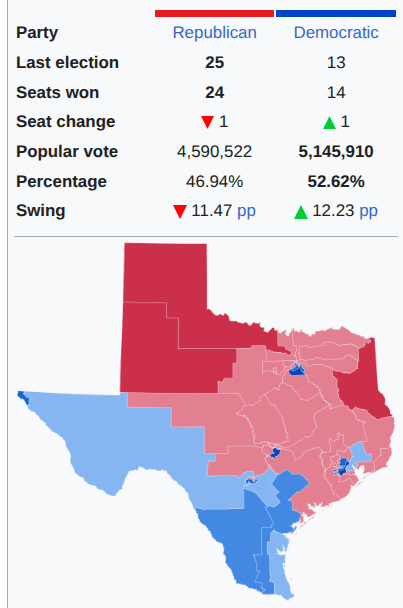
In the 2024 election, Republicans won 25 of the 38 races. The goal of the redistricting, then, was to get to 30, and that was an unambiguous fail: Republicans won only 24 races, and so actually went backwards one seat. The Democrats won several races that the redistricting had been designed to place beyond their reach. Maybe that looks like a dummymander but the details of the election returns tell a different story.
In the 2024 congressional races, when Texas Republicans won 25 of the 38 seats, they also won 58 percent of all votes cast in those 38 contests. This year, the Republican share of the vote in elections for US House in Texas dropped from 58% to 47%. Meanwhile, the Democratic share rose from 41% to 53%. Instead of losing by 17 points, the Democrats won by 6, and the net change in actual representation was a single seat out of 38. Another way to put it: for winning 53 percent of the vote, Democrats were rewarded with 37 percent of the seats.
Now, to come to a definite conclusion about the impact of the gerrymander, you’d have to compare the above figures with what they would have been if no redistricting had occurred. I’m not able to find data pertaining to that question. I only mean to make the point that, on the evidence, it appears that what some people are calling a “dummymander” was actually quite effective. It’s not likely that the Republicans did in fact double cross themselves. They got slaughtered at the polls, but their power was not diminished by as much as it would have been if they weren’t rigging the game in huge states such as Texas.


Leave a Reply