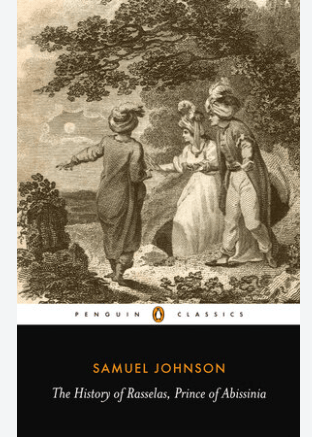
I’ve been reading Rasselas, by Samuel Johnson, which was first published in the same year (1759) as Voltaire’s Candide, a work that it resembles. Candide is a satire on the notion, advanced by religious apologists attempting to explain all the evil and suffering in a loving God’s creation, that we are despite appearances living in “the best of all possible worlds.” The characters sally forth and are subjected to one calamity after another, in the aftermath of which the intellectual of the group, Dr Pangloss, “professor of metaphysico-theologo-cosmolonigology” and philosophical mentor to the title character, without fail explains why all is nevertheless “for the best.” His determined optimism becomes progressively less tenable as the tale proceeds and the French work has attained sufficient cultural status for “Panglossian” to have entered the English language as an adjective denoting a bloviating, foolish optimist.
Johnson, who unlike Voltaire was devout, does not subject his characters to the killer storms, earthquakes, and tsunamis described in Candide. When his characters escape a kingdom of boring bliss, their investigations uncover instead hidden burrs of private distress. Commoners and the most exalted personages are afflicted in roughly equal measure. There is, for example, a fairly long section on the subject of marriage that includes the following dispatch concerning its common genesis:
A youth and maiden, meeting by chance or brought together by artifice, exchange glances, reciprocate civilities, go home and dream of one another. Having little to divert attention or diversify thought, they find themselves uneasy when they are apart, and therefore conclude that they shall be happy together. They marry, and discover what nothing but voluntary blindness had before concealed; they wear out life in altercations, and charge nature with cruelty.
Seems about right. All the characters talk in this manner, by the way, which is to say they all sound like Johnson. Someone has said that his brocaded, polysyllabic style has never been imitated without making the imitator ridiculous. Rasselas is not much of a contribution to the art of fiction–according to Johnson’s most famous biographer, it was dashed off in a week’s time in order to secure for its author a pay day after he had incurred funeral expenses associated with his mother’s death, though it now seems more likely that it was written in anticipation of these events. Either way, the poverty Johnson suffered before, in late middle age, receiving from the king a pension for his service to literature is part of why many of us love him, and as a kind of moral fable Rasselas is an exemplary work. Its theme, which I take to be that our miseries are mainly hidden, unsensational, and, with regard to provenance, traceable not to God but to our own folly, is attractive to me. It anticipates maybe the truest sentence in American literature, Thoreau’s dictum that “the mass of men lead lives of quiet desperation.” Incidentally, thinking of America and the author of Rasselas, Johnson was still alive at the time of our revolution and, as a proud Englishman and conservative subject of the king, undertook the composition of an indignant pamphlet, “Taxation No Tyranny,” in which he asked, “How is it that we hear the loudest yelps for liberty among the drivers of negroes?” I offer the detail because the racial views of eminent intellects from the past are often excused with mumblings about “the times they lived in.” Okay, fine–but not everyone on the Humanities syllabus needs to invoke the Zeitgeist defense.


Leave a Reply