This is pretty funny. But some part of the audience’s enjoyment must derive from the view that everything newfangled represents a decline from the bucolic days of an old guy’s youth, when we didn’t have to lock our doors at night and we worked math problems according to the teacher’s rubric that we memorized. I have no idea what “common core” entails, but I think the way I was taught to solve problems wasn’t great–it was more or less like learning a foreign language by memorizing a phrase book instead of by learning grammar and syntax while building up vocabulary.
For example, in the problem 135 9, my classmates and I were told to write 135 “inside the house” and 9 just to the side of the “house’s wall.” Then we ask ourselves does 9 go into 1? No. So now we ask whether 9 goes into 13. Yes it does, one time, so write 1 on the roof of the house right above the 3 in 135. It’s important, says teacher, to write the 1 above the 3 so that later you don’t get confused about what number to “bring down.” Then multiply 1 and 9, get 9, write it below the 13 part of 135, subtract, get 4, now it’s time to “bring down” the the next digit, 5, and so on. If you remember all the steps, and perform them in the right order, eventually the right answer appears on the roof of the house.
Lost in this arithmetic equivalent of
Gut morgen, Frau Schmidt. Wie geht es ihnen?
is the whole concept of what division is–in this case, putting 135 things in 9 equal groups. How many in each group? Well, I don’t know exactly, but I do know that I can put 10 in each group, because that would make 90, and then there’d be 45 left. Oh! Five more in each group, because 5 x 9 is 45. Now I’ve put 10 + 5 in every group so the answer is 15. It looks like this, with a harder problem worked out below:
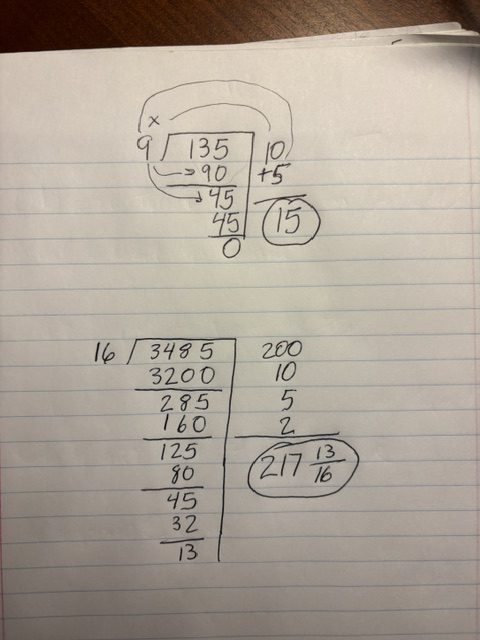
To me, this isn’t harder than the way I was taught, it takes up about as much room, which seems to be an issue with at least one comedian, and, as I said, it doesn’t elevate the mechanical performance of steps in a rubric over an understanding of what’s actually happening when you divide. To be sure, we don’t do a lot of math in school, because it’s subordinate to all the gender reassignment surgeries being performed forenoons in the lunchroom, but, if we did learn long division, this “partial quotients” method is something we’d teach.
That’s the end of my TED talk for MEA weekend.


Leave a Reply