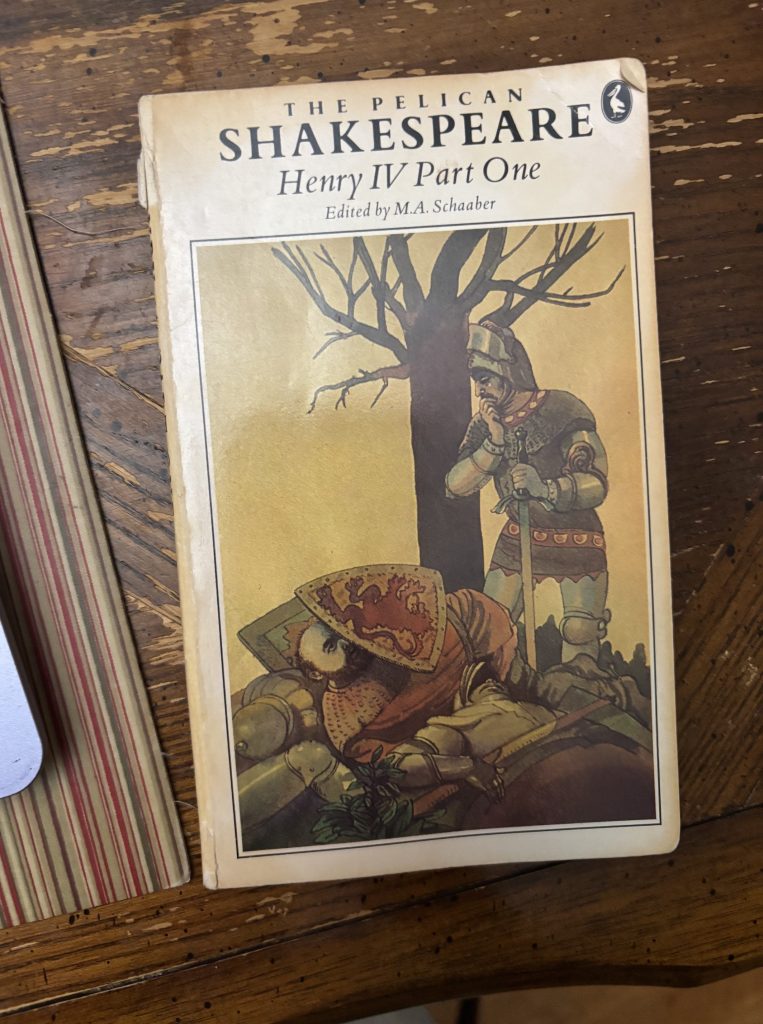
I just finished Shakespeare’s Henry IV, Part 1, a play that famously juxtaposes high and low scenes: the king and his counselors, Falstaff holding court at the tavern; the king and his counselors, Falstaff as inept petty criminal; the conspirators plotting against the king, Falstaff arguing with the tavern hostess about his unpaid tab; &c. The judgment of anyone you would ever want to hang out with is that the low scenes are way better. The likely reason for a Part 2 was to meet the demand for “more Falstaff,” and the theory is plausible largely because it would be weird if the judgment of the first audiences was different from that of all the subsequent ones, four centuries worth by now.
Had he been only a comic character, Falstaff would not take his place among Shakespeare’s greatest creations. HIs friendship with the dissolute prince places him adjacent to the geopolitical plot, and he is in the middle of the play charged with being an agent of “the king’s press”–we call it a military draft. Falstaff’s approach is one of the origins for the adjective, “Falstaffian.” To potential recruits of means he sells exemptions and uses the proceeds to bank roll his debauchs. The platoon he ends up with is made of witless and impoverished vagrants who can be cheated out of their pay, another revenue stream. This is the backdrop for the following passage, when the prince lays eyes on Falstaff’s recruits:
PRINCE: But tell me, Jack, whose fellows are these that come after?
FALSTAFF: Mine, Hal, mine.
PRINCE: I did never see such pitiful rascals.
FALSTAFF: Tut, tut! good enough to toss; food for powder, food for powder. They’ll fill a pit as well as better. Tush, man, mortal men, mortal men.
Tossed on a pike refers to impaling an enemy soldier on a giant spear and then, by lifting the weapon, throwing his corpse, or soon to be corpse, in the air. Powder is cannon fodder. Regarding “fill a pit,” Falstaff means that the members of his ragtag troop will fill a mass grave as well as their betters would. He’s excusing his self-interested recruiting tactics, but the argument is stronger than he realizes, unless he does realize it. On the eve of the big battle, in conversation with the prince, Falstaff expresses his nervousness, and receives from the prince the elevated reply that we all owe God a death. The prince then exits and Falstaff soliloquizes:
‘Tis not due yet: I would be loath to pay him before his day. What need I be so forward with him that calls not on me? Well, ’tis no matter; honor pricks me on. Yea, but how if honor prick me off when I come on? How then? Can honor set a leg? No. Or an arm? No. Or take away the grief of a wound? No. Honor hath no skill in surgery then? No. What is honor? A word. What is that word honor? Air–a trim reckoning! Who hath it? He that died a Wednesday. Doth he feel it? No. Doth he hear it? No. “Tis insensible then? Yea, to the dead. But will it not live with the living? No. Why? Detraction will not suffer it. Therefore I’ll none of it. Honor is a mere scutcheon–and so ends my catechism.
The high plot, relating to the plans and histories of kings and their well placed enemies, including preeminently Prince Hal’s moral ascent into that world, is conducted all in verse. Falstaff’s ironic commentary, a rebuttal in prose, is not less compelling on account of being tossed off rather casually by someone in need of a covering story. Who has honor? Someone, dead since Wednesday, who was over valiant that day. All his honor does nothing for him now. Falstaff’s catechism seems “modern” but the drama in which he plays his part was composed at the end of the sixteenth century.


Leave a Reply