• Journalist and author Garrett Graff has been looking into the crime rate among agents and officers of CBP (Customs and Border Protection). Some of his findings, as recently revealed in testimony before an Illinois state commission:

    Criminality is so rampant within CBP that it has seen one of its own agents or officers arrested every 24 to 36 hours since 2005 . . . .

    In total, according to CBP’s own discipline reports, over the 20 years from 2005 to 2024–the last year numbers are available–at least 4,913 CBP officers and Border Patrol agents have been arrested themselves, some multiple times . . . . To put that number in perspective:

    The population of CBP agents and officers who have been arrested would make it roughly the nation’s fourth largest police department–equal to the size of the entire Philadephia police.

    Indeed, for much of the 2010s and likely before and since, it appears the crime rate of CBP agents and officers was higher per capita than the crime rate of undocumented immigrants in the United States.

    People of Minneapolis: “You don’t say?”

    Transcript of Graff’s Fresh Air interview on this subject, here. YouTube video of his testimony before the commission, here.

  • As predicted, I stalled along the long open road of Henry Adams’s History of the US, but, as reading in bed is still my Ambien, I was lucky to stumble again upon the novels of Evelyn Waugh. The one everyone knows is Brideshead Revisited, which was made into a movie as well as a lauded miniseries starring Jeremy Irons. Maybe these are great, I don’t know: Waugh, however, wrote at least a half dozen novels that are way better than Brideshead. The “half dozen” I have in mind are his first two, Decline and Fall (1928) and Vile Bodies (1930), which were followed in 1932 by his best book, A Handful of Dust, and then, years later, by the long Sword of Honor trilogy, wherein Waugh’s World War II experience is turned to fiction in which one can luxuriate for months of bedtimes. There are many others–he was prolific–but I’d say these six are his “indispensable works.”

    For most of his adult life Waugh was a right-wing Catholic who would have thought the demise of the Latin Mass a sign of Western Civ’s collapse–and therefore somewhat of a strange bedfellow for me. I can’t now remember whether I knew this about him when I first laughed aloud in bed while reading Decline and Fall and Vile Bodies. Doesn’t matter. He was a gifted humorist and satirist. Imagine if Hemingway’s attitude toward his rootless hedonists had been one of urbane disdain. Waugh performs from on high the labor of a vivisectionist. If someone were to complain that the books are cartoons, my recourse would be to confess that I guess I love cartoons. Then, fresh off a honeymoon delayed by a lack of funds, Waugh’s wife leaves him for another man, he takes Catholicism as his new bride, and the comic elements of the first two novels, though still present, serve a deeper purpose in A Handful of Dust.

    The novel divides nicely into two parts. The first is set in London and Hetton, a fictional town about a half-day’s train ride away. Tony Last lives at Hetton with his wife and young son. His wife, Lady Brenda, starts spending a lot of time in London, and eventually takes a flat there because, she explains, she’s signed up for an extension course in economics. Personal development, and all that. Actually, of course, she’s having an affair with a fellow, John Beaver, who’s sufficiently ridiculous to have fit right into Vile Bodies. The scenes of Beaver prosecuting his feckless routines, which include spending a fair amount of time sponging drinks at his men’s club, are continuous with the two earlier novels. He’s thirtyish and still dependent upon his mother, who is also a piece of work–she’s the one who rents the flat to Brenda. Comedy arises from the reader’s suspicion, and then knowledge, of Brenda’s infidelity long before Tony suspects a thing. He never really suspects a thing. Their son dies in an accident at Hetton while Brenda is pursuing her pleasures in London. Tony stays behind to make arrangements while a friend travels to London to tell Brenda and bring her back to Hetton. With great skill, Waugh manages to describe a kind of suspended time in which Tony, devastated by loss, is watching a clock and calculating when Brenda will get the news. If he’d been worldly enough to know what she’s been up to, he might have hoped that they’d be brought back together by their common pain, but the boy’s death removes her last connection to her husband and she finally has to write him a note:

    You must have realized for some time that things were going wrong.

    I am in love with John Beaver and I want to have a divorce and marry him. If John Andrew had not died things might not have happened like this. I can’t tell. As it is, I simply can’t begin over again. Please do not mind too much. I suppose we shan’t be allowed to meet while the case is on but I hope afterwards we shall be great friends. Anyway I shall always look on you as one whatever you think of me.

    Best love from

    Brenda

    “Please do not mind too much.” “I hope afterwards we shall be great friends.” One feels that in the characterization of the self-seeking, vacuous Brenda there are ten million daggers aimed at Waugh’s ex, and in that case, English literature benefited from his private troubles. The way in which the comedy settles into tragedy, but lives on enough to mix an element of the farcical into the woe, is something new in Waugh.

    In the second half, Tony goes on a journey to South America. His old life, wife and son, is gone, and he needs, as is said, to “find himself.” (Waugh is contemptuous of all the peppy talk self-transcenders pep themselves up with.) This general situation always makes me think of the scene in Dances with Wolves where Kevin Costner says something along the lines of never really having known who he was until he came to live with the Indians, thereby inspiring the critic Pauline Kael to comment, “Dances with Wolves is a kid’s daydream of being an Indian. Costner has feathers in his hair and feathers in his head.” Waugh expands somewhat upon Kael’s acerbity. The wasteland of London’s “civilized” people is, in A Handful of Dust, implicitly contrasted to the uncivilized one in the Amazonian interior, where the locals, when Tony and his guide attempt to communicate with them, seem interested only in whether they have a good supply of cigarettes. “You have cigarettes?” Later, another faltering inquiry, and then, “You have cigarettes?” I said the contrast is “implicit” but this isn’t always true. Tony’s troubles in the jungle are sometimes interrupted by descriptions of what’s currently going on back in London. Early in the book, a man in Beaver’s men’s club, a Minister of Parliament, asks the bartender whether he knows anything about pigs:

    “No, why?”

    “Only that they keep writing to me about them from my constituency.”

    A bit of chit chat that advances Waugh’s general theme of decadence and waste, since the MP, who evidently represents a rural district, is seeking information from a bartender at his men’s club about topics of vital interest to his constituents. Maybe he would want to study up a little himself, perhaps from a more reliable source, such as, say, a hog farmer in his district? But Waugh isn’t done with the matter. One of the “interruptions” to Tony’s Amazonian debacle goes like this:

    Ten o’clock on the river Waurupang was question time at Westminster. For a long time now Jock had had a question which his constituents wanted him to ask. It came up that afternoon.

    “I should like to ask the Minister of Agriculture whether in view of the dumping in this country of Japanese pork pies, the right honourable member is prepared to consider a modification of the eight and a half score basic pig from two and a half inches of thickness around the belly as originally specified, to two inches.”

    Replying for the Minister, the under-secretary said: “The matter is receiving the closest attention. As the honourable member is no doubt aware the question of the importation of pork pies is a matter for the Board of Trade, not for the Board of Agriculture. With regard to the specifications of the basic pig, I must remind the honourable member that, as he is doubtless aware, the eight and a half score pig is modelled on the requirements of the bacon curers and has no direct relation to pig meat for sales in pies. That is being dealt with by a separate committee who have not yet made their report.”

    “Would the honourable member consider an increase of the specified maximum of fatness on the shoulders?”

    “I must have notice of that question.”

    Jock left the House that afternoon with the comfortable feeling that he had at last done something tangible in the interests of his constituents.

    Tony Last dies in South America, away from such scenes never returns from South America, where, near the novel’s conclusion, he’s subjected to absurdities that transcend question time at Westminster. The author’s newly minted Catholic faith is not overt in A Handful of Dust, but it isn’t hard to imagine that he might be the kind who’d seek solace in elaborate liturgies chanted in a dead language. He appears to have little hope for this world, or the people in it. There must be some relief, somewhere.


  • One day a few weeks ago I was dining in the school lunchroom when a kid a table over suddenly began vomiting just as a first grade teacher was striding into the room to collect her class. She veered from her original course and, as she’d already been moving, arrived at the scene of the trouble before anyone else. From behind, she put one hand under each armpit of the puker and lifted him out of there before too much more could drip into his lap. Then she stood guard over the puddle, holding one small and possibly contaminated hand, until reinforcements arrived. All in a day’s work. If you’d like to see her in less trying circumstances:

    https://www.facebook.com/reel/1580063246528085

    Crazy, crazy times at Ms. Fultz’s school, Valley View Elementary in Columbia Heights, Minnesota. Even before our pre-k student was nabbed by ICE–what a relief to get him and his bunny-eared stocking cap off the streets!–attendance had dropped precipitously. Parents are supposed to call in if their kid is going to be absent, and if they don’t, someone from the school office calls them. Consequently we knew that out of fear people were staying home instead of prosecuting their normal routines, which had included delivering their kids to Valley View in the morning and picking them up in the afternoon. To boost attendance, school staff have volunteered to walk kids to and from school. I guess there are legal reasons district employees can’t drive kids in their cars, but with the permission of parents, we can walk with them. I often see a group when I’m getting close to school in the morning. They go from house to house picking up kids, their number slowly accruing until they have everyone, and then they walk to school together.

    I believe there are like six neighborhood zones, times five days in a week, morning and afternoon, so about 60 shifts per week. All slots are filled by a volunteer, people like Ms. Fultz. It adds an hour to the work day, it’s cold out, the eastern sky just brightening in the a.m., and they need a plan for what to do if harassed, or worse, by agents of their own federal government.

    On the theory that laughter is good medicine for surviving life in Dystopia:

  • A picture of the 5-year-old Valley View student being detained by ICE Tuesday afternoon after school. According to our superintendent, the family has an open asylum case with a “no deport” order. Nevertheless, the pre-k student is “being held at a detention center in Texas.” A report by the local CBS affiliate, here. And Sahan Journal, here. The picture, in the Sahan Journal piece, of his teacher wiping away tears while listening to district officials talk about her student at a press conference today, is just about more than I can tolerate. Three other Columbia Heights students have been detained, two high-schoolers and a 10-year-old. What fresh hell next? “This is not the worst, so long as we can say, ‘This is the worst.’”

    It doesn’t make anyone safer, obviously. As has been said, the cruelty is the point.

  • Regarding the killing of Renee Good in Minneapolis, it’s clear that people are going to believe (or say that they believe) whatever it pleases them to believe. It seems a short step from there to the claim that the shooting is essentially a “Rorschach Test” and that objective truth concerning the event doesn’t exist: some will “interpret” the evidence this way, some that way, and there are only “interpretations,” no truth. If you think that’s a crock (and I do), this frame-by-frame analysis of the available video evidence by the New York Times, which is augmented by the synchronization of different videos, is invaluable. I’d encourage anyone to watch it.

    The Times’s narration tries to play it down the middle, but the evidence plainly contradicts the Trump administration’s account. The shooter, Jonathan Ross, was not “run over” or even “struck.” At most–and I doubt this–he was grazed by a slow moving vehicle as he leaned forward to shoot. Nor did Good try to run him over. If she had wanted to, she easily could have, because he walked around her car and was for a second or two a short distance in front of the middle of her front bumper. I doubt that’s what they teach you to do at Cop School, but that’s what he did. During the moments when Ross was most vulnerable, Good, instead of moving rapidly forward to run him over, put her SUV in reverse and backed up a few feet. She shifted to drive as Ross’s counter-clockwise circumnavigation of her vehicle reached the area of her left front corner. Then, turning the wheel sharply to the right, away from Ross, she began to move forward as he began shooting, once through the left edge of the windshield and then twice through the driver’s side window. There is always open space visible between his feet and legs and the SUV. While shooting, the cell phone with which he’d been recording Good struck her car and made a thudding sound that some have claimed was caused by the vehicle striking him. The mortally wounded Good stopped steering and her SUV crashed into a parked car at the side of the road. Ross, who according to the government had been “run over,” suffering “internal bleeding to the torso,” is seen walking normally in Portland Avenue immediately after the shooting. He doesn’t appear hurt, does not ask for help, and none of his colleagues seem concerned about his well being. They soon drive off. Though the government claims he required treatment at a local hospital, there is no record of this.

    The Times’s narration mentions that Ross put himself in danger by walking in front of Good’s car, and that this runs counter to common law enforcement training. Others have pointed out that his organization, the Department of Homeland Security, has a policy on use of force that emphasizes de-escalation and requires agents to deliver medical assistance when necessary. The video evidence indicates these were two additional failures. In subsequent encounters between ICE agents and Twin Citians who record and jeer at them, the agents have asked whether they haven’t “learned the lesson” of what happened to Good. But the official story about what happened to Good is that she was shot because she ran over an agent. That agents think people standing along streets blowing whistles and cursing them need to “learn the lesson” suggests to me that the problem wasn’t that Ross had been hurt or feared that he might be. The problem was that Good wasn’t afraid enough, and her partner, especially, a little too mouthy. The “lesson” the agents have in mind is: You all have to stop being mean to us, or we’ll shoot. It’s evident that they have a license to do that. Nothing is going to happen to Ross, but the DOJ is investigating Good, her partner, Minnesota’s governor, and Minneapolis’s mayor, which is why several of the top dogs in the local US Attorney’s Office resigned. Not every government worker connected to this saga is without honor.

  • I saw a Replacements tribute show at the Turf Club a week ago and have been listening to their records again ever since. My God. A friend and I like to play the game, Favorite album? Favorite song? For me, it’s changed, and it will again, but tonight my answer for the first game is Tim. Notwithstanding the most common free association responses to “punk rock,” so many of their songs are, um, tender. Here is the remastered “Swingin’ Party”:

    Not sure the phrase “toxic masculinity” had any currency, or had even been invented, when in the mid 1980s Paul Westerberg wrote this song, but today it sounds like a prescient rejection:

    If being alone's a crime I'm serving forever
    If being strong's your kind, well,
    I need help here with this feather.
    If being afraid is a crime we hang side by side
    At the swingin' party down the line.

    Trouble Boys, Bob Mehr’s history of the band, recounts how their first show ever was scheduled for a Minneapolis halfway house, and that it was cancelled when they showed up drunk. I think I remember that accurately; I seem to have lost my copy. For sure, the band was famous for sometimes being too drunk to play, and on at least one occasion Westerberg reached into his pockets and threw money into the crowd to compensate at least a couple attendees for having bought a ticket. These episodes are part of the legend, and some of my fellow fans may feel almost romantic about them, but “Here Comes a Regular,” which closes Tim, is an alcoholic’s lament. The lyric begins:

    A person can work up a mean mean thirst
    After a hard day of nothing much at all.
    Summer's past, it's too late to cut the grass
    There ain't much to rake anyway in the fall.

    And sometimes I just ain't in the mood
    To take my place in back with the loudmouths.
    You're like a picture on the fridge that's never stocked with food.
    I used to live at home, now I stay at the house.

    If you’re still with me, here’s the whole thing; hard to describe in words the elegiac force of the song:

    And my current fave song, answer to the question posed by Game 2, is the one that includes this memorable representation of futility:

    For the moon you keep shooting
    Throw your rope up in the air

    You get the idea: the rope just falls to the ground, right? The song, about a break-up from the point of view of the dumped woman, a mom, is called “Little Mascara”:

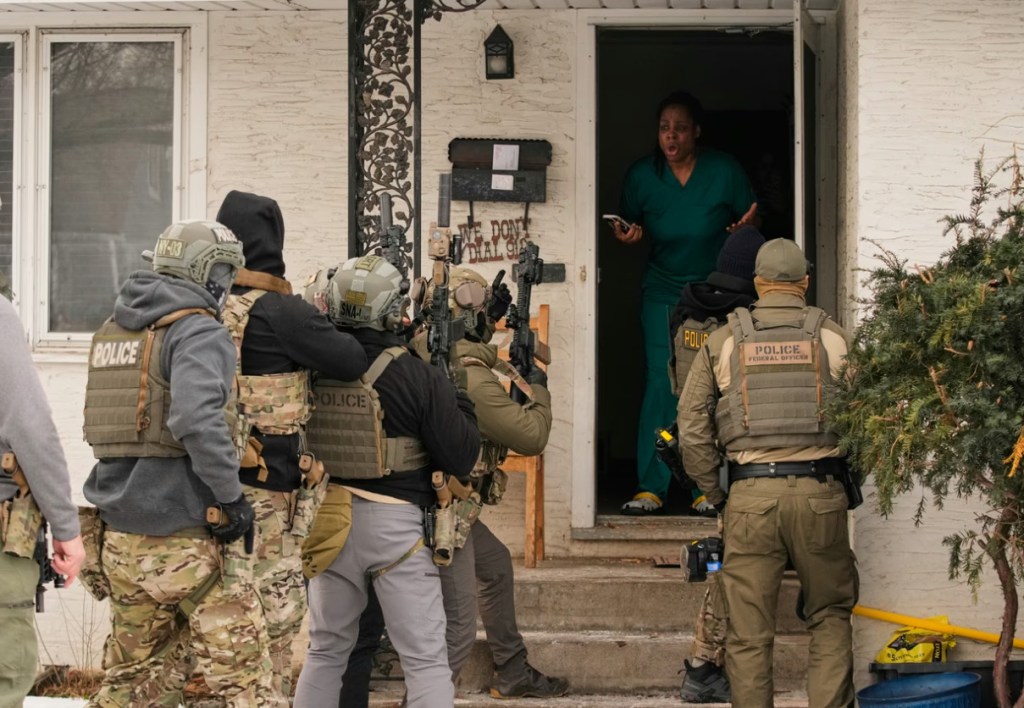
  • At first glance, I thought the phone in her right hand was a cigarette, which is about the only thing that could have made for a more indelible image: like Pam Grier contemplating the dumb white cops in Jackie Brown.

    Unless someone is completely cropped out, I think there are seven of them. Note that the fellow at the left has his hand on the grip of his holstered pistol–because, I guess, two rifles at the ready might not be enough when you’re face to face with a black lady wearing slippers.

    Careful, darling, everyone now knows that they don’t call 911, either.

  • Bought a copy of the Minneapolis daily paper yesterday for the first time in a couple of decades. I think I could have read every word, excluding the sports box scores and the ads regarding mortgage foreclosures, in around an hour and a half. Is it always so skimpy? The sports box scores did not include one for the Timberwolve’s game the night before. The locals had rallied from a big deficit to beat the Spurs by one point, but the only thing you could learn about the game in the hometown team’s paper is that it had been “late.” I don’t know when the game ended. It started at 7 p.m.

    My main motivation for dropping a few extra dollars at the store had been curiosity about how Minneapolis’s only daily paper was covering the ICE operations in our city. Answer for that was “also skimpily,” as evidenced by the front page, which had above the fold on page 1 the headline “Problems at food supplier persistent” but nothing up top about what everyone is talking about, since it’s temporarily (I trust) put an end to ordinary life in the Twin Cities. For example, where I work, a school for PreK through 5th-graders in Columbia Heights, a third of our students were absent yesterday, the first day back after a switch to e-learning last Friday. Eerily quiet in the building. The sound that a full lunchroom of little kids makes was down to something the librarian would tolerate. Meanwhile, the StarTribune’s editorial page ran opinion pieces under the following headlines: “Funding freeze harms working people, but why are we surprised,” “The gun violence prevention need from the Legislature this year,” “Minnesota River needs leadership, not more delay,” and “Emergency eye care is disappearing when it’s most needed.” True, the “readers write” section had letters about no other topic than the one that was largely ignored everywhere else. I guess it’s only the professional journalists who think ICE is barely a story?

    I should say, though, that other organs of local journalism are distinguishing themselves, at least intermittently. KARE-11 posted this interview with two south Minneapolis residents whose constitutional rights were plainly violated by ICE; it’s valuable, also, for the picture provided of what’s going on at the Fed’s detention center at the Whipple Building (to say nothing of the unassuming heroism of the interviewees):

    On this topic of the quiet deeds of ordinary people, the “press” however trails far behind randos with cell phones. Here’s a homemade piece of journalism documenting an encounter that occurred in Minneapolis during one of ICE’s door-to-door actions:

    If you listen carefully, you will hear her mutter, after she wins and the goons are trudging off, “What the fuck!”–the expletive standing out from the accented English with which she courageously stood down the bullies. “This is my home. I belong in Minneapolis. I am a citizen. I do not need ID in my house.”

    In a different part of the city, this was the scene when ICE paid a visit to one of my favorite establishments, Wrecktangle Pizza at the intersection of Lyndale and Lake:

    Video of federal agents getting run out of Lyn Lake this afternoon. Agents drop a gas can at the end and someone kicks it back at them.

    — Wedge LIVE!™ (@wedge.live) 2026-01-12T23:15:24.400Z

    Within seconds of the warning whistles being sounded, people pour into the street to express their disgust and the ICE dudes have to slink away, though not until after setting off a chemical irritant (someone kicked the device back at them). I might be in love with the woman in the bright skimpy top who didn’t have time to put on a jacket. These are good stories, StarTribune! The owners of Wreck Pizza, by the way, were likely targeted on account of their decency. Also, by chance I know that they have an attractive Happy Hour–$4 house wines and $6 margaritas, 3 to 6 p.m., seven days a week.

  • Probably it would be prudent for me to stay off of social media when events in my stomping grounds are the lead story in international news reports, and not for the first time in recent memory. But being a boomer, I occasionally peruse what my kids derisively refer to as BoomerBook, and unfortunately cannot give myself an order to regard with equanimity, for example, Tom Emmer, who represents probably Minnnesota’s reddest congressional district. I should just laugh but Jesus. I trust Emmer’s not dumb enough to believe his own b.s. and is only pandering to his dumbest constituents, but maybe that’s charitable: maybe he really is that dumb. Anyway, based on his BoomerBook post, he thinks that the statement put out by the Department of Homeland Security (DHS) after yesterday morning’s homicide on Portland Avenue was drafted by Joe Friday. Here it is:

    Just a few comments, paragraph by paragraph.

    1. Riot? What riot? By now everyone with the slightest interest in the matter has seen the videos. There was no riot. I love the way they insist upon the lie: in one sentence “rioters,” then again “violent rioters,” even though everyone knows there wasn’t a riot. Portland Avenue wasn’t “blocked,” either. The street is too wide for one vehicle to achieve that feat. ICE could’ve driven around the little SUV like everyone else was doing. After all, they had “targeted operations” to conduct. The puffed up vocab of boys playing at being cops.

    2. DHS purports to know what was in the mind of the shooter, just as they purport to know what was in the mind of the woman he killed. Of course they don’t know. Also, they don’t want anyone to investigate these matters, which is why they’ve thrown Minnesota’s BCA off the case. A close analysis of the video evidence proves the woman wasn’t trying to run anyone over, but it’s a fool’s errand to take up that subject with someone who thinks there was a “riot” going on.

    3. “Used his training”? Give me a break. The DOJ has a Manual that includes its policy on use of force. Here’s part of what it says:

    [F]irearms may not be discharged at a moving vehicle unless: (1) a person in the vehicle is threatening the officer or another person with deadly force by means other than the vehicle; or (2) the vehicle is operated in a manner that threatens to cause death or serious physical injury to the officer or others, and no other objectively reasonable means of defense appear to exist, which includes moving out of the path of the vehicle.

    Moreover, the ICE guys refused to permit a doctor on the scene to check on the woman they shot, and did nothing to help her themselves. The video evidence proves this, too. Yet one section of the DOJ’s Manual is entitled “Affirmative Duty to Render Medical Aid.”

    4. “The alleged perpetrator was hit and is deceased”–finally, a true statement, though couched in the passive voice. Another way to put it might be that an ICE officer, in violation of his training, if he had any, shot a woman in the face three times, at point blank range, and this is according to Hoyle, because he was at the side of her car, which was threatening to lurch sideways, as cars do.

    5. The referent for the “This” with which this paragraph begins is all the foregoing bullshit. I’m sorry but the evil Democrats are not forcing the Trump administration to lie.

    6. “An evolving situation”? The whole point of this statement has been to insist that everything about what happened is known and reflects the Glory of Trump and the depravity of his foes. In any event, the content of the conclusion is a broken promise, because everything new we learn comes from ordinary people, like the Portland Avenue resident who said the ICE guys were shouting contradictory commands at the woman. “Get out of your car!” “Get your car off the road!” Our state’s BCA would investigate this claim, and others, and come to a conclusion about what’s true and what isn’t, which, again, is why the Feds have booted them from the case.

  • It’s a footnote to a sidelight, but watching Trump speak this morning about the events in Venezuela last night, I almost felt a little sorry for the guy. He can barely read a text that’s been prepared for him, and when, perhaps impatient with his own bumbling progress, he freelances for awhile, the result is comically irrelevant asides that soon subside into incoherence. At sea, he finds a place at random in the prepared remarks and restarts his unsteady way through them. Cycle through, repeat, repeat. Should probably be grateful that none of his diversions concerned the water pressure in shower heads or the flushing power of American toilets.

    I feel that he’s declined considerably from his reality TV days, but then, he did in the prime of life bankrupt some casinos. No doubt “running” Venezuela will not be too big a task for him and the brain trust lined up behind him as he splutters along.