• If you read around very much in the right-wing media world–in my case, a guilty pleasure that’s yielded a metric ton of entertainment value–you soon comprehend that a leading theme, maybe the gold-medal winner, relates to the supposed liberal bias of what they sometimes call “legacy media,” which means New York Times, BBC, Reuters, NPR, Associated Press, CNN, your local big city daily, if you have one, etc., etc. I am among those who think by far the biggest part of the alleged “bias” should be attributed to honest assessments of the facts and evidence connected to a particular case. We have phrases that have attained the status of memes to illustrate our point–for example, “People trained in medical science and public health say that vaccines protect against disease, unnecessary suffering, and premature death, but at this diner in southern Indiana some old white men wearing red hats, and two young mothers who home school their kids, have quite a different view of the matter.”

    There follows a description, fortified by copious quotations, of opinions that might fairly be described as “completely bonkers,” delivered in sober tones by supposed left-wing employees of “legacy media” whose critical faculties seem to have been slaughtered by the salt-of-the-earth vibe emitted by numbskulls. The media is thus captured in a trap set by the wingers. The former task of evaluating the merits of competing claims has been abandoned, because it’s widely regarded as “bias.”

    A useful exercise, I believe, is just to pay attention to who turns out to be right. Along this line, consider the recent case of the missile strike on the elementary school in Iran on Feb. 28, the first day of the war. Wingers immediately claimed that the school had been hit, not by Israel or the United States, but by a failed Iranian missile that fell back to earth near its launch site. This wasn’t advanced as a hypothesis, a possible alternative explanation that should be weighed alongside the claims of Iranian state media, which blamed the US. It was asserted as fact. An X user with the handle Chaya’s Clan stated:

    A failed missile launch in Iran caused the projectile to fall on a school. Images captured the moment it failed, fell back to ground, and struck.

    This post, including the allegedly dispositive image, was then reposted by user David Khait with the comment, “It was a failed missile launch by the IRGC that fell back to the ground and struck the elementary school.” John Hinderaker, of the right-wing Power Line blog, then embedded Khait’s tweet in a post that, having excoriated Reuters for reporting on the claim of Iranian sources, concluded: “Not surprisingly, it turns out that it was a failed Iranian missile that hit the school.”

    The source for all this certainty goes back to the anonymous Chaya’s Clan and a picture that proves nothing. One of the amusing side notes of this episode is that after Hinderaker embedded the tweets in his blog post, a “community note” was appended to the original:

    This image has been geolocated to Zanjan, over 1,300 km from the girls’ school in Minab, by multiple investigations. It has nothing to do with the school.

    Hinderaker may or may not know that this community note now appears in his post, which credulously accepted Chaya’s Clan claim about a failed Iranian missile. As the “legacy media” pursued the story, it became increasingly clear that a US Tomahawk missile had hit the school and killed around 175 civilians, most of them young girls. In a post titled “Lies, Damned Lies, and Journalism,” Hinderaker nevertheless disparaged a New York Times story revealing that, at about the time the school was hit, an adjoining target was struck by a Tomahawk missile. Since the US is the only party in the conflict with Tomahawk missiles, this seemed a significant development, but Hinderaker, following up on his post featuring the discredited photographic evidence, insisted it meant nothing: his point was that people were reading the story as if it said the school was hit by a Tomahawk missile, when actually it only said that an adjoining site had been struck by a Tomahawk missile at about the same time as the school was struck by … something. He congratulated himself for this subtle observation even while quietly retreating from his former position. He had put it forward as a settled fact that the school had been struck by a failed Iranian missile. Now he wrote:

    My guess is that the military investigation will conclude that the school was struck by an errant Iranian missile, but by that time the left-wing press will have firmly implanted the impression that it was ours.

    He wrote that on March 9. On March 11, the New York Times reported on the progress of this military investigation. Here’s the lede:

    An ongoing military investigation has determined that the United States is responsible for a deadly Tomahawk missile strike on an Iranian elementary school, according to U.S. officials and others familiar with the preliminary findings.

    That was almost a week ago now, and I think it’s fair to say that Hinderaker, by his silence, is admitting that the the school was hit by a US missile. The sequence of events, then, looks like this:

    1. Elementary school hit by a missile, killing well over a hundred kids. Iranian sources blame US.

    2. Wingers berate press for reporting what Iran claimed. They say, with no evidence, unless you count an irrelevant photograph attached to a tweet, that the school had been hit by a failed Iranian missile.

    3. Subsequent news reports make it appear more likely that the US is at fault. Wingers insist this reporting is just more balderdash from “legacy media,” aka the fake news.

    4. Yet more reporting attributes to officials in the US government an admission that, according to the conclusion of a preliminary investigation conducted by our military, the school had in fact been struck by a US missile in an apparent “targeting error.”

    5. Without admitting their error, wingers fall into silence on the topic. Oh well, in a minute there will be something new for them to pontificate upon. In the fullness of time, they might be right about something.

    One more possibly unrelated point, though it does pertain to the war, or “excursion,” as Trump has begun calling it. (My guess is that someone in his administration told Trump that, for legal reasons, he should call the war not a “war” but an “incursion,” but he doesn’t know that word and so calls it the similarly-sounding “excursion,” which alas has connotations of casual travel.) Did Trump and his cabinet of geniuses not foresee that Iran, in response to being attacked, would try to close the Strait of Hormuz? Or did they foresee it but have no plan for preventing it, or for what to do if it happened?

  • Last night, Timberwolves on the west coast, 10 pm local start on a school night, and I, apparently mesmerized by my faves’ poor play, did not rise from the couch and shut it off till around half way through the fourth quarter, or roughly 12:15 am, long past when the outcome was plausibly in doubt.

    Well, you are probably wasting your life doing trivial things you enjoy, whereas I’m wasting mine doing trivial things that even I hate, so, even? Doesn’t sound even.

    At least I share the misery with my roommates. From this morning’s family chat:

    On another note, I was today years old when I found out that you can bet, on Polymarket, on whether the Second Coming of Christ will occur before the year is out. The odds currently stand at 4%, which to me seems high, and I was thinking of betting against it till I learned of the complexities involved in setting up an account, and even then you might not be eligible to bet, depending on your location, etc., etc. Saved by sloth from betting against Jesus.

    Honestly, though, isn’t it a no-brainer? Money is only going to be of any use in 2027 if 2026 turns out to be another of those years in which he does not return in all his glory to judge us. The “affordability” issue, in other words, would be rendered moot by the Second Coming. On the other hand, if it develops that this year is in this one respect like the 2000 or so that preceded it, then you’ll still need to pay the bills, and it would therefore make sense to pick up some extra scratch by betting against the Second Coming.

  • I bought a car today. Gazing into the foreshortened future–maybe have to do it one more time, according to the actuarial charts. That’s fine. It was at a dealership, so you will understand that I was reminded of this:

    I too passed on the sealant. It was around half way down the list of extras, about the time I said, “You know, I’m gonna pass on all of these.” The “finance manager” regarded me from on high. “Not your thing?” he asked.

    I agreed that it was not my thing. Pretty obviously his thing.

  • I was looking at some 5th-grade math tests that kids took at school today. You can see how, after the above problem is set out, students are instructed, “Write your answer and your work or explanation in the space below.” The main exhibit of this 5th-grader’s response cracked me up:

    I can’t Explain, I allreaty am trying my best! and It’s hard

    Big circle around it. When I was finished laughing, I looked at the rest of his work, and it’s perfect. Easy to love a self-effacing 5th-grader who gets the right answer to a somewhat challenging problem. This was the twelfth and last problem on the test. He might have been coming to the end of his endurance.

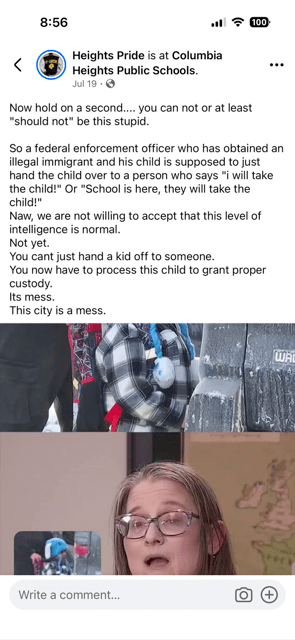
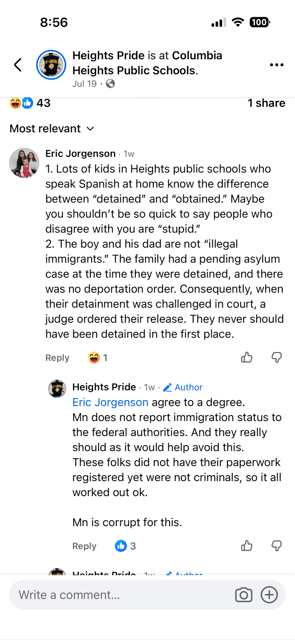
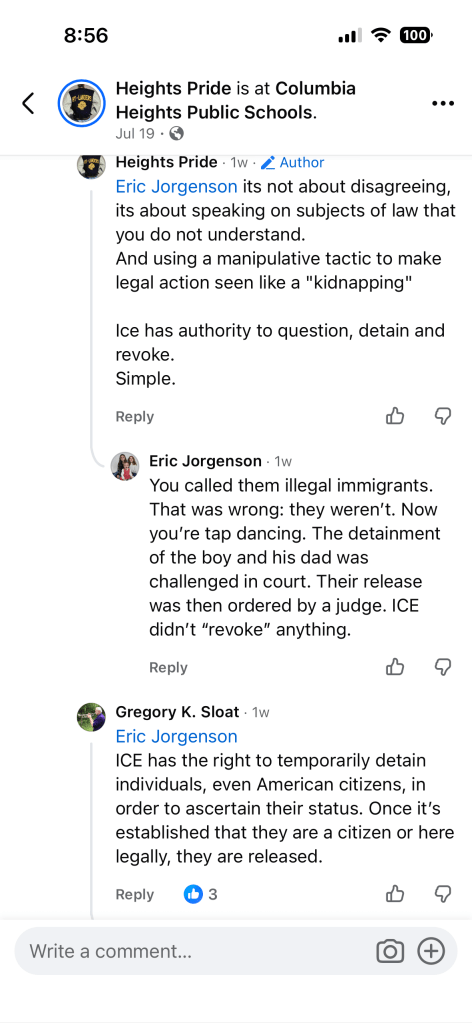
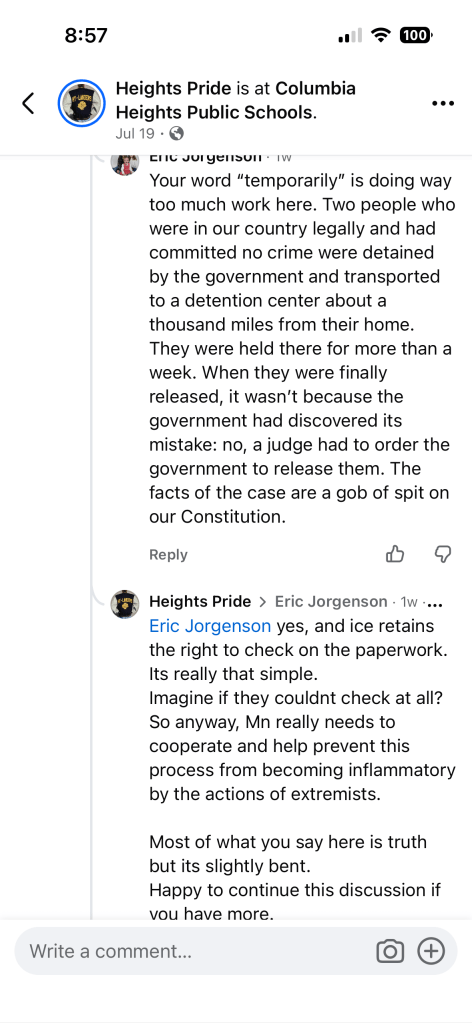
    At Valley View, we learn firsthand to hate ICE, and also how to calculate the volumes of rectangular prisms. In Ed-speak, I believe this is referred to as “whole child education.”

  • Now and again I’ll hear someone say something like, “Oh, yeah, The Onion is funny as hell,” which, as compliments go, seems to me a little limp: a phrase such as “national treasure” would be more apt. They’re currently running a story beneath the headline “ICE Agent Injured After Repeatedly Trying To Detain People In Neighborhood Mural.” The subhead declares, “Community Art Project Accused Of Assaulting Federal Officer.” The article includes the detail that the officer “was heard howling in pain after a punch aimed at a Hispanic child’s face fractured several bones in his right hand.” Whole thing here.

  • The Guthrie is currently performing Macbeth, and I’ve thought about standing in line for a rush ticket one of these evenings. If I don’t get in, I could always have an over-priced drink before heading home. That would be a pretty big night for me!

    Macbeth is by a wide margin the shortest of Shakespeare’s great tragedies–I’m considering Hamlet, Othello, and King Lear to be the other members of that group–and it’s been speculated that part of the play Shakespeare wrote must have been lost. A better theory is that it was going to be performed at court, and James I was known to have a short attention span. Me likewise, especially when sitting with my chin too close to my knees, which is why I might see the tightly constructed Macbeth. Every inch a king.

    I’ve been reading around in all the supplementary material supplied by my Signet classic paperback of Macbeth, and I see that the editor, Sylvan Barnet, takes up the theory that Shakespeare didn’t write the plays attributed to him. It was pleasant for me, a mere hobbyist, to see a renowned scholar say precisely what I’ve long thought to myself: that the appeal of the theory is essentially a snob appeal, since it arises from the notion that a bumpkin from the provinces could not have been the genius who wrote these works. Thus the proposed alternative authors are all university educated, or titled, or both. It reminds me that Melville said the sea was his Harvard and his Yale. No one thinks Moby Dick was written by the Ivy-educated son of an industrialist.

    Of course, Shakespeare lived longer ago, comparatively little is known about his life, and as a result there is room for invention. Or, at least, there was room for invention after more than 150 years had passed: Shakespeare’s contemporaries would have thought the idea of a different author odd, since they were in a position to know. The numerous contemporary references that take for granted that the playwright was William Shakespeare–which include Greene’s insult, Francis Meres’s assessment, Ben Jonson’s poetic tribute, and the preface to the First Folio by Shakespeare’s theater colleagues John Heminge and Henry Condell–could not have been regarded as strands of an intricate conspiracy until Shakespeare had been long dead.

    Times change, and in 150 years a few people began to think it suspicious that so little was known about the life of a man possessing Shakespeare’s cultural status. But there’s a reason the Globe Theater was across the Thames from Westminster, in the district of bear baiting pits and other dubious entertainments. Shakespeare made a good living, but the prestige that sparks interest in biography came later. I remember being enrolled in Introduction to Shakespeare, and so was in attendance for the first lecture, on Shakespeare’s life and times, how the female parts were played by prepubescent boys, all of that, when during question time a student asked whether in Elizabethan England actors were cultural icons like they are today. This was in winter quarter, 1981, Reagan had just been elected, and the teacher, Lonnie Durham, answered, “Oh, no, no, no, no. Why, if Shakespeare could have known that one day an associate of his, a mere actor, would rise and become the leader of a great and powerful nation, he would have been astonished, and mortified.”

  • I tuned into the State of the Union Address last night, because I enjoy the absurd pageantry that precedes the actual speech, and, of course, once Trump starts talking anything can happen, and you might not want to miss it. Once he started talking, however, I was quickly bored, plus over on the Big-10 Network the Gophers were giving #3 Michigan a bit of a tussle in Ann Arbor. Before I switched channels, Trump had repeated his claim that, thanks to him, America is “the hottest country on earth,” but I was watching basketball by the time the flatter fest with the hockey players began. I guess the goalie is now going to get the Presidential Medal of Freedom? Good for him. He’ll be in the company of Rush Limbaugh.

    Regarding the claim that the country’s economy is HOT, I looked up the recent GDP numbers. Assuming the ubiquitous “AI overview” is reliable, the growth figures over the previous year, coming forward from 2017, the first year of Trump’s first term, look like this:

    2.3%, 2.9%, 2.3%, (-3.5%), 5.7%, 2.1%, 2.5%, 2.8%, 2.2%

    So that’s 2017 through 2025: Trump’s first 4-year term, followed by the four Biden years, followed by the first year of Trump’s second term. We’re back! Too hot to touch!

    I don’t know what Trump said to wrap things up, probably about the time the T-wolves’ late game on the west coast was headed into halftime, but according to Ann Coulter it was “beautiful” and reminded her that to be President you should probably have to be at least a fifth generation American, since it takes awhile for love of country to get in the genes. Trump’s mother was born in Scotland, and his father’s parents were both born in Germany–circumstances that, in the world according to Ann Coulter, may explain some things.

  • Keeps happening, but I still feel startled to see a place I know well, including especially the people who work there, featured in national news spots. Here’s a segment from yesterday’s PBS News Hour on my place of employment, Valley View Elementary in Columbia Heights, Minnesota:

    I’m eager to associate myself with Ms. Fultz and her friends–in Elementary Ed, our classmates and colleagues are “friends,” as in “Line order, please, friends”–over and against those who will think this is essentially a sob story. If, however, you’re wondering about facts relating to the impact immigrants are having on American life, the Cato Institute has done the research. The talking points of the Trumpistas concerning how immigrants are “sucking us dry,” etc., don’t stand up to the scrutiny supplied by “a prominent American libertarian think tank dedicated to the principles of individual liberty, limited government, free markets, and peace.” Some top line findings of the 30-year study:

    • Every year from 1994 to 2023, immigrants paid more in taxes than they received in benefits.
    • Immigrants generated nearly $10.6 trillion more in federal, state, and local taxes than they induced in total government spending.
    • Accounting for savings on interest payments on the national debt, immigrants saved $14.5 trillion in debt over this 30-year period.
    • Immigrants in all categories of educational attainment, including high school dropouts, lowered the ratio of deficit to gross domestic product during the 30-year period.
    • Without the contribution of immigrants, public debt at all levels would already be above 200 percent of gross domestic product–nearly twice the 2023 level and a threshold some analysts believe would trigger a debt crisis.

    The details are similarly arresting. On the topic of crime that one hears so much about, Cato finds:

    Immigrants impose 44 percent lower costs per capita on prisons, felony policing, and courts than the average person. From 1994 to 2023, immigrants were about half as likely to be incarcerated as the US-born population, reducing the burden on courts and policing for serious crimes. This is despite the fact that a significant portion of incarcerated immigrants are incarcerated or detained for immigration offenses that the US-born population cannot commit.

    Is it true that immigrants impose a burden on our educational system? Cato:

    Immigrants cost the US education system 50 percent less per capita than the US population overall. Because of special programs for English-language learners, immigrants in school can be more expensive than other students in school. But because immigrants are much less likely to be in school, they cost the system much less overall. Most immigrants arrive in the US after they have completed their schooling. Moreover, in higher education in most states, illegal immigrants must usually pay full tuition. At the same time, most noncitizens enrolled in institutions of higher education are international students, and each international student at public universities covers the cost of enrolling two other students. As a result, immigrant students impose lower costs per student in higher education.

    And so on. None of the anti-immigrant talking points turn out to be true, according to the research of a leading conservative-friendly think tank. Here are the first few sentences of Cato’s concluding statement:

    Immigrants contribute to the United States’ economy in many ways. Their primary contribution is the goods and services they directly produce. However, they also reduce the burden of government spending for the US-born population. Our analysis in this paper shows that immigrants generated a fiscal surplus of about $14.5 trillion from 1994 to 2023, that the average immigrant is much less costly than the average US-born American, and that immigrants impose lower costs per person on old-age benefit, education, and public safety programs.

    The entire Cato paper, including definitions, methodology, etc., is here.

  • Since there’s hardly anything more common, at least from atop a bar stool, or key board connected to a social media site, than the opinion that politicians are universally corrupt, ignorant, and ineffective, I’m going to drop in here a clip of a US senator performing his job well. For context, the Trump administration has nominated the witness, Jeremy Carl, for a position in our State Department sufficiently high up to require Senate confirmation. He therefore appeared the other day before a Senate committee on which Chris Murphy, Democrat from Connecticut, is a member. Without any theatrics, Murphy asks straightforward questions–you’d think they would have been anticipated, but apparently not–that elicit one feeble response after another. It takes a couple of minutes to show the world that the guy should not have any job outside of a right-wing think tank. His nomination is still pending, but at least one Republican has announced his intention to vote No.

    Can’t help but append a couple of comments. “Food ways,” lol, what is he even talking about?. But my favorite moment might be toward the end when he says, righteously, “I’m a civic nationalist, not a racial nationalist!” Have you ever noticed how all these Big Thinking Bros. have conducted taxonomic labors from which Hercules would shrink? If only the top-line heading above all the categories and subcategories was something other than Dopey Bigot.

    With a lot of witnesses, the best way to make them look bad is to give them a chance to talk. Inject yourself enough to preclude a filibuster and to point out when fair questions haven’t been answered. Well done, Sen. Murphy.

  • About a week ago, Trump said that the federal government should “take over”–“federalize”–voting procedures in 15 states. He didn’t say which 15, but probably not South Carolina or Idaho, right? They get the right results. He did name three cities that he thinks are “crooked”: Atlanta, Philadelphia, and Detroit. These are in the “swing” states of Georgia, Pennsylvania, and Michigan. But what really puts a target on them, I think, is that they are majority African American and overwhelmingly Democratic in their political orientation. What, though, is the evidence that they’re cheating for Democrats? It’s not a secret that African Americans prefer the Dems, and not just by a little. Is there any evidence of something shady going on? Partly to try and answer that question, and partly because I just enjoy wallowing in election data, let’s look back at what happened in these three venues over the last several presidential elections–see if anything seems fishy.

    In Fulton County, Georgia, which is where Atlanta is, Trump’s share of the vote has barely budged from election to election. The two times he won the state (2016 and 2024), he got 27 percent of the vote. When he lost in 2020, he got 26 percent. Were all three crooked, or just the one he lost?

    In Philadelphia County, which is coterminous with the city of Philadelphia, Trump averaged 17.5 percent of the vote in his two victories. In 2020, when he lost Pennsylvania, he got 18 percent.

    In Wayne County, Michigan, home to Detroit, Trump’s share of the vote has gone up the three times he’s been on the ballot: 29 percent in 2016, 30 percent in 2020 (when he lost Michigan), and 34 percent in 2024.

    We can look at other numbers, too. It’s just that nothing seems funky. For example, in two of the three venues–Philadelphia and Wayne Counties–Trump has actually done better than Republican standard-bearers of the recent past. In Philadelphia County, Trump has averaged about 18 percent of the vote; Romney, McCain, and W Bush averaged only about 16 percent. In Wayne County, Trump has averaged 31 percent of the vote, while the three previous Republican nominees averaged 27 percent. I guess the “massive election fraud” perpetrated by Democrats has been going on for years! It’s a wonder that they sometimes let Republicans win!

    Georgia, a growing state that has been trending toward the Democrats, presents a different picture. Over the last six presidential elections, the Republican share of the vote in Fulton County, in percentages, farthest back to most recent, has been: 40, 32, 35, 27, 26, 27. This shrinking share of the Republican presidential vote has been somewhat more dramatic in the Atlanta suburbs. For example, the figures for Cobb County, which abuts Fulton on the northwest, look like this: 62, 54, 55, 46, 42, 42. In 20 years, Republicans have gone from winning Cobb County by more than 20 points to losing it by 15. But Trump says Fulton is corrupt because . . . everyone knows the real reason: so many African Americans, of course they’re cheating! Doesn’t matter that there’s no evidence. It’s like the children’s joke about pink elephants hiding in cherry trees. Have you ever seen a pink elephant in a cherry tree? See how well they hide?

    In Michigan, there are cases roughly parallel to what’s happened in the Atlanta suburbs. Trump narrowly won Michigan in 2016, when he lost Wayne County by 37 points. Four years later, he narrowly lost the state, and he again lost Wayne County–this time, by 38 points. He and his band of absurd lapdogs howled about “irregularities,” etc., in Wayne County. But consider, for example, Kent County, in western Michigan, the state’s most populous county outside of the Detroit metro. Trump carried the county by 48 to 45 percent in his 2016 victory. Then, in 2020, he lost Kent County by 52 to 46 percent. Going from a 3-point win to a 6-point loss is a dramatic shift, especially compared to Wayne County–the result in Wayne County doesn’t even qualify as a shift–but for Trump and his supporters “Grand Rapids” doesn’t have the sinister verve of “Detroit.”

    Well, one could go on. Is the voter turnout in these big Democratic counties variable and suspicious, even if the percentage splits are not? No. Are the presidential splits much different than in statewide races for US Senate? No. There was supposedly “massive fraud” that is undetectable in any data. Of course, there is too the fact that many of Trump’s specific claims are laughable. He’s said he would have carried New Hampshire but for the “bus loads” of people invading from Massachusetts to cast illegal ballots. Ridiculous. He’s said he won Minnesota all three times. Also ridiculous. Et cetera.

    I began by confessing that part of my purpose here is just to give myself an excuse to look up stuff that interests me. If you’re skeptical about any of it, you should consider that there are a lot of people who dedicate their professional lives to the study of American electoral politics, and they agree: Trump is full of it. Also, we have a mechanism for handling election challenges and disputes: the courts. Whenever Trump has pursued this avenue of relief, he loses and loses and keeps on losing–because courts are big on evidence and facts..

    Yet he keeps running his mouth on the topic. He’s now using his worthless claims as a pretext to “federalize” the upcoming midterms in certain unnamed states. That the Constitution gives states the power to oversee elections is, it seems, a detail to be swept away. It doesn’t require x-ray vision to see what the game is. Trump wants to cheat. The endless flow of accusations–they’re always confessions.