I ran into my stepkid at a coffee shop. Are the bonds of step-fatherhood severed by divorce? I’m still claiming him. I was nursing 2.5 cups of coffee through around 25 pages of a book, Donald Hall‘s A Carnival of Losses: Notes Nearing Ninety. It’s a sequel of sorts to Essays After Eighty, which I read a few years ago. Next on my list is Roger Angell’s This Old Man, published after the author had passed ninety. Hall didn’t quite make it. Angell was 101 when he died in 2022.
As time proceeds, it seems I’m more and more attracted to geriatric literature.
Stepkid had his school laptop and was going to study until it was time to meet me and his half-sister at the local spot where we have supper once a week. He mentioned that the coffee shop across the street, though in some ways superior to the one we were in, closed at 6. I already knew that and mentioned that Caffetto, on 22nd Street just west of Lyndale, is open till midnight. He already knew that. Thinking about it now, seems like maybe “nerding out in coffee shops” is determined more by nurture than nature. His genes aren’t telling him to do it, I know that. Could just be coincidence. I got my nurture and nature from the same two people, and neither one of them read books. One didn’t even drink coffee.
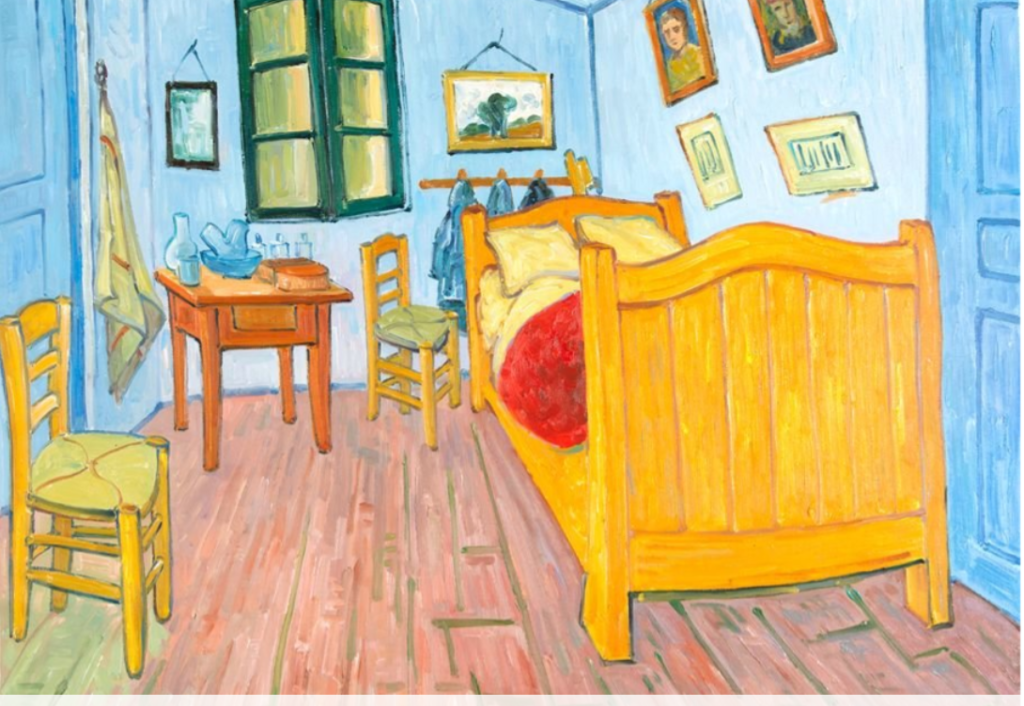
Our party is smaller because stepkid’s other half-sister now lives in Madison, Wisconsin, where there is a so-called university. Every reminder of her absence makes me sad, even though many of the tokens have a (thoroughly routed) pleasant aspect. The bill at the restaurant was well under a hundred dollars. I walked into her bedroom and it was neat as Van Gogh’s. It occurred to me that I hadn’t washed clothes for a couple of days and when I went to prosecute the task, the basket was just half full.
Sister of the absent girl is unafflicted. “Lydia didn’t take a lot of her clothes!” she jubilantly reports.
Michele Tafoya grew up in SoCal, where she attended high school in the affluent surfer ‘burbs of Redondo Beach and Manhattan Beach. She then went to college at Cal-Berkeley followed by business school at USC. Her first media job was in Charlotte, North Carolina. It’s hard to tell from Wikipedia and other online sources at what point Minnesota became home (or maybe it would be more apt to say “center of operations”). Maybe her husband is from here? Anyway, she isn’t, and now that she’s a candidate for the entry level political job of US senator, she’s committed a few gaffes that are the source of a meme relating to her ignorance of local cultural byways. I’ve spent the morning reading through a page where individual specimens are collected, and a lot of them are laugh-out-loud funny. At least, I laughed out loud. Here are some of my favorites. It seems vaguely apt that almost no one knows how to spell her name so I’m going to preserve the misspelling.
Michelle Tafoya isn’t sure whether or not Drew Pearson pushed off.
Michelle Tafoya takes the last bar from the pan.
Michelle Tafoya says “excuse me” instead of “ope, just gonna sneak pastcha here.”
Michelle Tafoya needs a map to get around at the state fair.
Michelle Tafoya thinks “hot dish” is a warning.
Michelle Tafoya never drove to Hudson on Sunday for a case and a handle.
Michelle Tafoya’s all-time favorite Viking is Herschel Walker.
Michelle Tafoya pronounces it “Weigh-zattah.”
When Michelle Tafoya’s neighbor gets stuck in the snow, she closes the curtains.
Michelle Tafoya likes Soul Asylum because she thinks it means “only one refugee allowed.”
The aforementioned collection is here. Hat tip to Greg Walker for performing this community service.
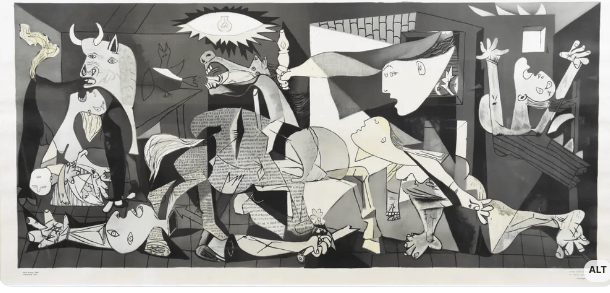
According to pablopicasso.org, the artist was living in occupied Paris during World War II when some Nazi soldiers invited themselves into his apartment. Seeing Guernica (above) displayed on a wall, one of them asked, “Did you do that?”
“No, you did,” Picasso is said to have replied.
I read that today. It must’ve been a big apartment because the painting is 25.5 feet long (and 11.5 feet high). I hope the anecdote is true. It’s true that the Nazis did it. From the Wikipedia article:
Guernica is a large 1937 oil painting by Spanish artist Pablo Picasso. It is one of his best-known works, regarded by many art critics as the most moving and powerful anti-war painting in history. . . . Prominently featured in the composition are a gored horse, a bull, screaming women, a dead baby, a dismembered soldier, and flames. Picasso painted Guernica at his home in Paris in response to the 26 April 1937 bombing of Guernica, a town in the Basque Country in northern Spain, by Nazi Germany’s Condor Legion and the fascist government of Italy.
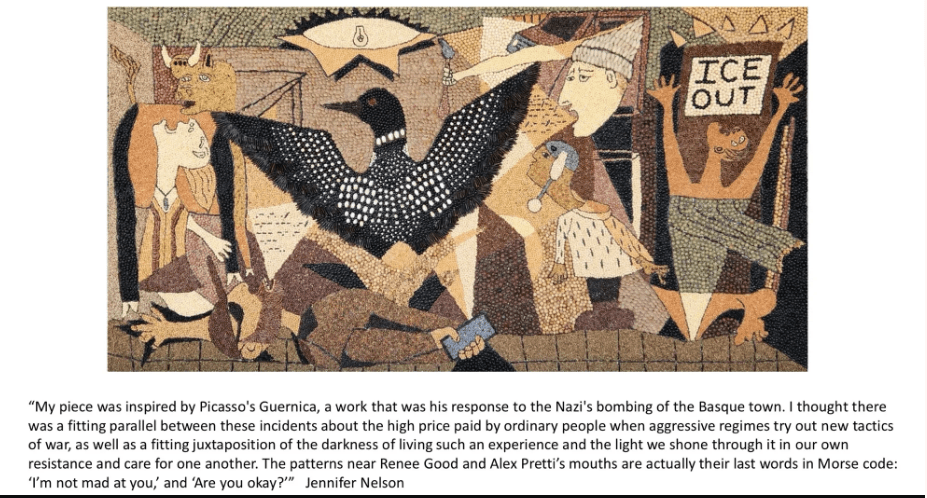
In other art news, the Minnesota State Fair opened today. This city slicker has been bored by all the agricultural stuff ever since spending interminable tracts of time, maybe a half hour or more, with my grandpa on Machinery Hill. But if I go this year I’m going to check out the crop art, as I understand there are a lot of works addressing news made in Minnesota since the last State Fair. Here, for example, is the entry of Jennifer Nelson, from Fridley, Minnesota:
I like to imagine a fair-goer wandering through the crop art displays right after having picked up some buttons at the GOP booth. “Did you do this?” they might ask someone standing by Ms Nelson’s composition.
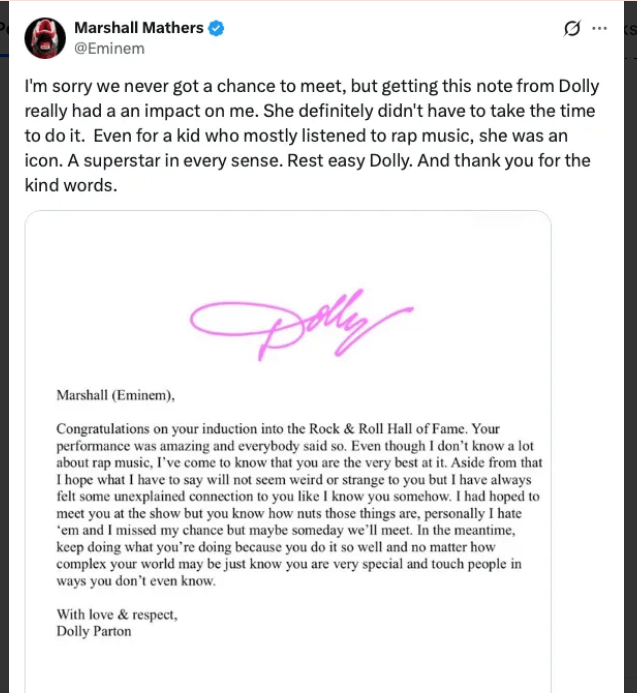
Regarding the outpouring of love for Dolly Parton, here is a tweet from Eminem in which he posts a note he received from her on the occasion of his induction into the Rock & Roll Hall of Fame:
And, regarding “Huckabee swings, hits a fair ball,” here is a link to an interview, conducted by The New Yorker’s Isaac Chotiner, with a retired IDF commander who is now working as a volunteer for Looking the Occupation in the Eye, a group that tries to protect Palestinians from settler violence in the West Bank. I’m sure it’s behind a paywall so here are some excerpts:
Q: What does protecting Palestinians in the West Bank entail for a group like yours?
A: The settlers are trying to ethnically cleanse the Palestinians in lots of ways, and one of them is with violence. There are other ways that they are trying that have to do with the Israeli legal system, but when the government cannot do things legally, the settlers try to expel Palestinians from their villages and their homes. So what we are doing is coming to these communities or villages–and we aren’t big enough to go everywhere–and we are staying there twenty-four hours a day, seven days a week, and when the settlers attack, we try to stand between them and the Palestinians. Sometimes we call the police or the army. They don’t help all the time. Sometimes they do O.K. We also try to take the settlers to court. But we try to place our bodies between them . . . .
Q: So the hope is just that settlers won’t commit as much violence with a Jewish Israeli like yourself present?
A: Their main aim is to expel the Palestinians from their villages. We want them to stay and not let the settlers expel them. We know, and the Palestinians know, that they will start by attacking people on the outskirts of the village, rather than the center of the village. And if those people run away, the next houses will be the ones closer to the village. So we try to protect them and stop them from having to run away, and we do what we can. But the first thing is to protect them. And we set up cameras. We also try to help with water and electricity . . . .
Q: So [the current Israeli government wants] to change facts on the ground before the election?
A: Absolutely, they want to occupy as much as they can . . . .
Q: How have your conversations with Palestinians changed over the past few months?
A: They are very worried about what is happening. There are many more people that need help than we are able to help. People call asking for help, but we cannot help everyone. What can I say? Many of them are very brave. I don’t have one good sentence to put in your piece. They have families. And they don’t want to give up their homes.
Lots of affecting tributes, especially from hitherto anonymous beneficiaries of her philanthropy, like the African American musician who says he didn’t know till he got to college that school fund raisers for band were practically a universal phenomenon, because “Dolly Parton paid for us.”
But maybe my favorite goes to “William Shakespeare,” the name under which a social media account posts a daily quote from Shakespeare’s collected works. Today’s was probably the first time the entry was a mere stage direction:
–out of concern that me agreeing with Huckabee, Trump’s ambassador to Israel, about something outside the realm of arithmetic could be a sign that we are living in the end times. If you read the interview linked to above, you’ll see that the case against the settlers is about as unambiguous as 3 + 2 = 2 + 3. Just the worst kind of naked thuggery.
It’s a little interesting that Huckabee should feel free to state the obvious. If Trump isn’t too far gone, he must by now resent Netanyahu for having pimped the Iran war to him. Talk about being played! It could be that Huckabee, being on the scene, accidentally blurted the truth, but it could also be that Netanyahu’s role in luring Trump into a huge blunder has lowered his stock to the point that Huckabee feels free to say that even in Israel 3 and 2 make 5.
The most chilling part of the interview relates to the role of the Israeli police. The settlers–the terrorists–are trying to force Palestinians out of their houses and off their land, and when the police are summoned, they arrest no one and pray with the criminals. It will be objected that that’s what the Palestinians say, but maybe Mike Huckabee can back them up. The settler movement on the West Bank is patently illegal, yet it has persisted for years, so it’s clear that the Israeli government tolerates, or abets, the lawlessness.
It will probably do me no good since I’m plainly an anti-Semite, but, being a dweebish book worm with no interest in hunting, fishing, or NASCAR, I feel like I could almost qualify as a Nordic, secular Jew. Moreover, it’s possible to find Jews who agree with me. The University of Minnesota recently had to pay an Israeli historian $250,000 after reneging on a job offer. The problem was that the historian, Raz Segal, had written an editorial in Jewish Currents in which he called Israel’s actions in Gaza “a textbook case of genocide.” After the offer was withdrawn, Segal obtained, through public records requests, copies of emails revealing that when state legislators, donors, and pro-Israel groups launched a campaign against his employment, the University at first defended its hiring decision but eventually buckled. In an article in The Guardian, Segal is quoted to the effect that he hopes the size of the settlement encourages others who have been fired, suspended, or investigated for criticizing Israel to “fight back.”
Now and then, when one of the suburbanites in my life asks how long it’s been since I was last pistol-whipped within a block of my house in Minneapolis, I work into the conversation how I like taking the bus to get around: I point out that, for seniors, it’s two dollars for all you can ride in a day, and you get to meet a lot of interesting people. They regard me through narrowed eyes and I assume they’re wondering whether I’m kidding. I must be kidding.
Kidding a little bit, because some of the interesting people are interesting mainly in an annoying sort of way. It seems that people who rely on public transportation self-select for having mental health challenges. I used to ride mainly during rush hour, on a bus connecting downtown Minneapolis to Edina by way of West 50th Street, which skirts the south shore of Lake Harriet–law firm employees and their socioeconomic peers headed to and from the office. But now I ride about in the middle of the day and am struck by how many of my new fellow passengers talk to themselves. It’s surprisingly common for a rider to speak a transcript of their mind’s workings. In the works of James Joyce the flow’s subject matter is less frequently sexual. There are also a significant number of cell phone calls of elevated volume. Sometimes you can hear both sides of the conversation, one of them loud and clear through the bus passenger’s phone, which is on speaker. In a city of more than 400,000 people, I’m also struck by how many of these characters know each other. When someone new boards, the stream of consciousness narration often comes to an end so that the normal pleasantries can be performed. “Hey Joe, how ya been?”Joe appears genuinely happy to see the fellow who had been narrating his thoughts and a friendly but loud conversation begins. Everything is loud.
The music is another thing that’s loud. Apparently people want everyone to know what kind of music they like, and their taste is rarely mine. But I’m finally arriving at my topic, because once their taste did match mine, and the owner of the boom box was not a member of my demographic group. She was female, probably about 20, and, as it was a hot day, I’m guessing you could see a relatively high percentage of all her tattoos and piercings. She appeared under nourished–possibly too continually hopped up to remember to eat. While we were on the bus together I heard from her play list two full songs and parts of two others. Of the four, I can’t remember two: they were unfamiliar to me, but I think I sort of liked them. This was one of the two I knew, maybe my favorite Stones song:
And the other one I knew:
I thought of this episode from my life as a bus rider this morning while lying in bed and learning from Cathy Wurzer that Robert Plant turned 78 today. He’s English, of course, so is allowed more than one act in life. Here he is, not very many years later, exercising that prerogative:
Not sure that Alison Krauss’s voice is what I like most about her, though I love her voice. I hope that waif on the bus is still having birthdays, too.
The above is from the New York Times’s coverage of last night’s US Senate primary in Alaska. Every candidate, from whatever party, is in the same field, and the top four finishers advance to the general election–no separate Democratic and Republican primaries in Alaska. As you can see, while the top four advance, the general election is going to be between Democrat Mary Peltola and the incumbent Republican, Dan S. Sullivan. The third place finisher, Daniel J Sullivan Jr, who got less than 3 percent of the vote, is a retired teacher widely regarded as a “spoiler” candidate–he’s exploiting the coincidence that his name matches that of the incumbent.
As you can also see, the result, with 80 percent of the vote tabulated, tends to confirm the view that this red state Senate seat is one that the Democrats can flip. If you give “real” Dan Sullivan all the ballots marked for the “other” Dan Sullivan, “real” Dan Sullivan, the Republican incumbent, is still a few thousand short of Peltola’s total. And Peltola is no novice: she has represented the state in Congress as its at-large representative–the entire state is a single congressional district–which means that in the recent past she has won statewide elections in Alaska. It’s been argued that the so-called jungle primary has benefited her, since, in her first victory, only three candidates received a significant number of votes, and two of them, Sarah Palin and Nick Begich, were Republicans. But Alaska’s use of ranked choice voting casts doubt upon the theory that Peltola won only because the Republican vote was split. In her first election to the House, Peltola received 40 percent of the vote in the first round, compared to 31 percent for Palin and 28 percent for Begich. It’s true, then, that the combined Republican vote was substantially more than what Peltola was able to garner. But, under the provisions of ranked choice voting, a candidate has to get to 50 percent to win, and the election therefore was determined by the second choice indicated by Begich voters. You might think that Begich voters would prefer Palin, another Republican, and in fact they did, but so narrowly that after Begich’s votes were redistributed Peltola had won, 51.5 to 48.5 percent. If you do the math, just over a third of people who voted in the first round for Republican Begich preferred Democrat Peltola to Palin.
Well, the argument about ranked choice voting is for another day, but I personally am in favor of any means of allowing voters to express their opinion more distinctly. Permit us to divulge not only who we like the most but also who we hate the most. The result of the “second round” tally indicates that, had Peltola won a Democratic primary and Palin a Republican one, Peltola would have won the general election on account of either her cross-over appeal or Palin’s radioactivity, take your pick. Note, too, that ranked choice voting frees us of the dilemma usually described by the phrase “strategic vote.” If you’re thinking that a vote for your favorite candidate will help the one you most dislike to win . . . no worries, vote for your fave, it will help hold the object of your hate below 50 percent, and then indicate who you think is second best, too.
But, it’s argued, ranked choice voting is so confusing. Sure, lots of things are confusing to the easily confused. Is it really necessary to dumb down our entire democratic civilization in order to avoid confusing people who are probably also confused by roundabouts, self checkouts, and the prose of opinion pieces in the newspaper?
Okay, maybe the ranked choice debate turned out to be for today, at least to a degree, but what really interested me about the above Times graphic was the geographic pattern of the vote. Here in the lower 48, it’s almost a universal law that metropolitan areas are strongly Democratic in their political orientation, whereas the rural and small town vote is overwhelmingly Republican. One consequence of this is that, in any relatively close election, the ubiquitous red-blue map looks like a Republican romp–until, on inspection, it turns out that the occasional dark blue dot marks the location of a city, and the encircling lighter blue its populous suburbs. But this doesn’t seem to be the case in Alaska. Perhaps four-fifths of the map is Peltola’s color, and the only reason the overall vote was somewhat close is that Sullivan did well in and around Anchorage, where 40 percent of Alaskans live. I’ve checked and this pattern seems to hold. For example, here is the map for the 2014 US Senate race in Alaska–I picked it because it shows what an evenly divided statewide election looks like:
The Democrat won the blue areas, and got more than 70 percent of the vote in the dark blue areas–but lost the election by 2 percentage points. I’d like to know why the rural-metropolitan divide in Alaska is the reverse of what prevails in the rest of the country. Even being clueless about that, however, it appears that this year’s primary map, if repeated in the general election, will net the Democrats a Senate seat. When Republicans win, they are competitive in the southeastern panhandle, and they win the Kenai Peninsula in the south central part of the state. Yesterday, Peltola beat Sullivan in every district of the panhandle, including by 63 to 28 percent in the Juneau district. She also got more votes than Sullivan across the Kenai Peninsula, which is home to several mid-sized towns–mid-sized by Alaska standards–that, according to this article, typically favor the Republicans, as they did in 2014 and, I notice, by a wide margin in the last presidential election.
Yesterday’s Twins game at the Field of Dreams site was only on Netflix, and they’re off today, so my television viewing hasn’t been much more than a half hour of “Jeopardy,” which alas and alack was enough to make me withdraw the fond forecast, made herein, that the end of the primary election campaign would give us a brief respite from political advertising on TV. My thought had been that campaigns would take a few days off to work up some new attack ads, now that they know for sure what the November match-up is going to be. Wrong! It seems they were ready for every eventuality. We’ll never know what Michele Tafoya and her consultants think of Angie Craig. What a loss!
I’ve found another ad I like, however. I had praised this one, and now I like the one I’ll paste in below. It’s an “attack ad” that manages to be kind of lighthearted. Is it “dirty” to call attention to your opponent’s criminality? I say No. The ad also cleverly suggests that someone who isn’t honest about small things won’t be honest about big things either–I’m thinking about the line mentioning that the courthouse in which Paxton stole a pen is the same courthouse in which he was indicted for financial fraud. As soon as I type that, I begin editing myself, because, while the theft of a pen does seem a small thing, this particular one cost a thousand dollars. But let it stand. Paxton says he didn’t realize the pen wasn’t his. I’ll admit it’s more plausible than a bank robber saying he didn’t realize the money wasn’t his, but not by much.
Singer and songwriter Nanci Griffith died on this date, August 13, five years ago, in Nashville. She was 68–my age exactly.* According to her NYT obituary, here, the cause of death was unknown on account of her expressed wish that there be no formal statement or press release within a week of her passing. The article on her in Wikipedia says only that her management team attributed her death to “natural causes.” She had been diagnosed and treated for breast cancer in her early 40s and for thyroid cancer a couple years after that.
She called her parents “very, very irresponsible,” according to a detail in the obit, but her dad, who was divorced from her mom when she was 7, took her to see Townes Van Zandt when she was a young teen. By that time, she had already been performing gigs at coffee shops and clubs around Austin, Texas, where she grew up, and from Van Zandt she learned to make use of her Texas heritage in songwriting. She lived to perform with Van Zandt “Tecumseh Valley,” one of his songs that had made the deepest impression on her when she saw him that night with her dad.
Given her dysfunctional family background and pre-teen initiation into the night music scene, it’s perhaps a little surprising that, at 18, she enrolled at the University of Texas and graduated, four years later, with a degree in elementary education. She then taught kindergarten and first grade in Texas for a couple of years. The obit says she “put aside finger paints” when she began having more success with her music, which to me seems offensively dismissive of kindergarten teaching, but whatevs–she was indisputably doing well with music, though it took a while for her to land a contract with a major label. More than one of her songs became hits when recorded by another artist: Kathy Mattea had a breakout success with “Love at the Five and Dime“; Emmylou Harris and Willie Nelson did “Gulf Coast Highway” as a duet; Suzy Bogguss did “Outbound Plane.” Griffith joked that it didn’t bother her and in fact she was relieved that “Kathy, not I, will have to sing ‘Love at the Five and Dime’ for the rest of her life.”
For reasons that are to me somewhat mysterious, being from “the South” seems to mean more to southerners than, say, being from the Midwest means to me. Is it because they lost the war? I don’t know, but something must explain everyone knowing that Nanci Griffith is a Texan, while hardly anyone knows that John Prine grew up in a Chicago suburb. One thing is certain: Griffith, who habitually performed with buttons promoting liberal politicians and causes displayed prominently on her guitar strap, would have been for Talarico. Her song that she said meant the most to her was “It’s a Hard Life Wherever You Go,” which addresses “the troubles” in Ireland and connects them to racial bigotry in America–“if we poison our children with hatred . . . makes it a hard life wherever you go.”
I said other artists had hits with her songs, but sometimes it went the other way: here she is performing Prine’s “Speed of the Sound of Loneliness”:
The girl from the dysfunctional family was married once, for about six years, and had no children. The detail from her obit that seems unintentionally in line with her musical themes is, “Complete information on survivors was not immediately available.”
*In a New Yorker cartoon, a strap-hanger on the subway is reading the obituary page over the shoulder of a fellow passenger. You see on the page not what would actually be there but what he’s thinking: “Just two years older than me! My age exactly!”