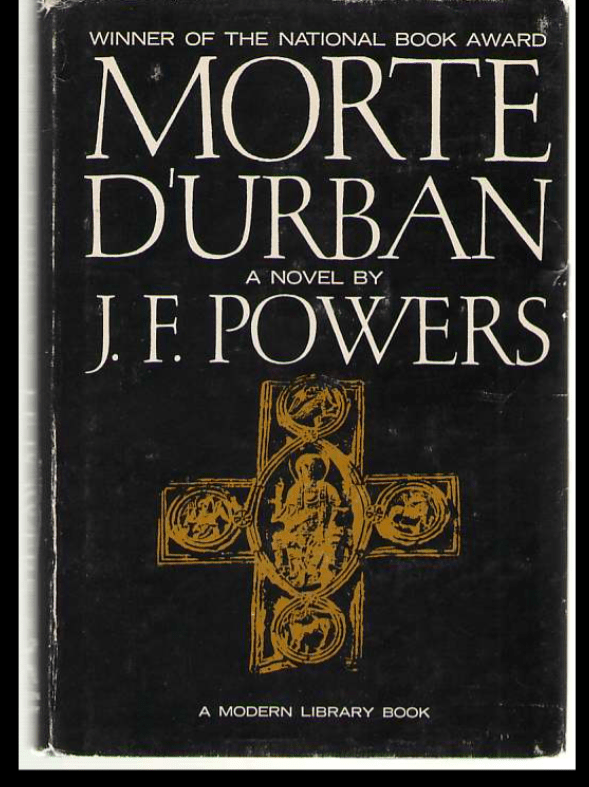
Reading J.F. Powers’s Morte D’Urban again. I do it every five or six years, which seems to be about the right interval for the memory of the deliciousness to have subsided enough for my enjoyment to attain its former height. Powers was born in Illinois in 1917 and lived for most of his adult life near Collegeville, Minnesota, where he taught creative writing and English literature at St. John’s. He died there in 1999. His great subject is Catholic priests, who, in a phrase deployed by diverse commentators, are on the receiving end of his “gentle satire.” I suppose that’s apt, assuming just two words are allowed: closer than “bitter satire,” for sure. You can see that “satire” is the easy part. Does “gentle” mean 90 percent “loving” and only 10 percent “unsparing”? Because that would seem inaccurate. None of these guys is the platonic form of priest, and many are real putzes. They aren’t able men. They are mediocre specimens of humanity. IBM probably wouldn’t take them, still less the Notre Dame law school, but the Church will.
For me, part of the pleasure derives from the drawing back of the curtain. I don’t know anything about what a priest’s life might be like, but I once had innocent notions that, in Powers’s fiction, take a beating. Here are some things his priests don’t do. They don’t discuss with each other questions of theology. They don’t argue about the interpretation of a Scriptural passage. They exhibit approximately zero interest in their Church’s teaching and doctrines. They don’t labor over the preparation of sermons. (Maybe they once did, but by now they have one for every occasion, and “mail it in.”) They don’t make pastoral calls on ailing parishioners. To fill the space that might have been devoted to such activities, there is a great deal about the comforts afforded by their living arrangements–or the lack of comfort. Father Urban Roche, to whom the title Morte D’Urban alludes, hobnobs about town with rich Catholic businessmen, and has a taste for the high life. He’s also a skilled golfer. As a golfer, I can’t help noticing that, in American literature, being good at this sport is invariably a sign of moral taint. See also, for example (and most famously), The Great Gatsby.
Anyway, as the novel opens, Father Urban is stationed in Chicago, capital of the Catholic Church in America, Midwestern Division. The attentive reader will notice that he stands somewhat above the general aura of mediocrity. Billy Cosgrove, the rich businessman he runs with, would have been bored by the other members of the Order, but Urban is good company. The relationship bears fruit: Cosgrove makes a valuable donation of real estate and the Order is able to move its headquarters from a dilapidated building downtown to a facility that, as Powers describes it, sounds more like the offering of a suburban office park. Urban is aware of his superiority and chafes at his position below that of the Provincial, a man who, appearing on stage for the first time, receives the following notice:
The Provincial, a lean, pale, damp-looking Pole with a hairline winding up and around like the endless seam of a baseball, sat at his desk cleaning his fingernails with a letter opener.
I said part of the pleasure is the pulling back of the curtain, but that’s behind the steady accrual of moments like this one: concise, closely observed, comic, memorably expressed. The damp-looking Pole soon banishes Urban to a backwater retreat house in rural Minnesota. Why? We aren’t really told, but we are told enough to surmise that maybe the Provincial, like a lot of mediocrities who are in charge, doesn’t like having around for an underling someone more competent than he. The Provincial, after all, wasn’t the one who secured the large gift. But let’s slow down and note: the Order is populated largely by dullards, but one man stands out for his abilities, and those abilities are not at the service of what some (like J.F. Powers?) might consider the proper object of a religious vocation. If the damp-looking Pole or someone above even him resents Urban, it’s for the wrong reasons.
So Urban is off to rural Minnesota, and he’s a Chicago kind of guy. Likes all the good restaurants, the bustle and the pleasures. For the native Minnesotan, the novel acquires local interest. Here’s his first impression from the train window:
The country beyond Minneapolis seemed awfully empty to him, flat and treeless, Illinois without people. It didn’t attract, it didn’t repel. . . . November was winter here. Too many white frame farmhouses, not new and not old, not at all what Father Urban would care to come home to for Thanksgiving or Christmas. Rusty implements. Brown dirt. Grey skies. Ice. No snow. A great deal of talk about this on the train. Father Urban dropped entirely out of it after an hour or so.
Ah, my heritage–could have been driving to my grandparents’ place! He arrives at his destination and finds the retreat house in a barely habitable state. The concern with comfort seems for once appropriate. You can see why the priest in charge, Wilf by name, occupies a place below the damp-looking Pole on the organizational chart. On Urban’s first night, the curtain opens on this scene:
Father Urban looked through some issues of Life, while Brother Harold, at the long table, worked at his show-card lettering, and Wilf, after putting pencils and scratch pads around at the other table, stared out at the night, fooled with the radio, which had a bad hum, and rocked himself.
If memory serves, Urban will have many adventures here.
 Eric the Blue
Leave a comment