• I tuned in Game 7 of the World Series in order to test the hypothesis that “baseball is boring” and whoa!

    Just kidding, of course. Not about watching the game. I’m one of those who can’t answer the question about how I became a baseball fan, because as far as I know it predated my interest in solid food. But I can’t remember watching a game like that one. The last two of the ’91 Series, arguably, but I had a dog in that fight.

    I think my favorite play was the drive to the fence in left field with the winning run on third base and two outs. Was that in the ninth or the tenth inning? The Dodger left fielder was staggering backwards, and may not have caught it. He’d been playing shallow: usually you’re okay with a ball landing in front of you if it means you can catch the deep ones, but in this situation his team loses if a batted ball bounces anywhere in the outfield. So he’s crowding the infield, and the batter drives one directly over his head, the hardest kind to go back on–it’s a lot easier if you can angle back, which is exactly what the center fielder did, arriving on the scene in straight-away left field just in time to leap and catch the ball above the head of his wobbling teammate. Play on! The guy had just entered the game the batter before. You hardly ever see a defensive substitution in the middle of an inning, but for that preceding at-bat a sacrifice fly would have ended the game, so one assumes the Dodgers inserted an outfielder with a stronger throwing arm. Then he makes a fabulous catch instead.

    If you vote for the game-tying home run in the ninth inning by the Dodgers’ weak-hitting second baseman, when everyone was waiting for the next batter, Superman Ohtani, to have his chance . . . I won’t argue. Actually, it was the same fellow who made another do-or-die fielding play for the Dodgers, when his strong throw after catching an awkward hop completed a force out at home on what would have been the Jays’ winning run–different inning from The Catch in left field. Just too much to recount, including stuff I’ve probably already forgotten: memorable plays immediately overshadowed by even more memorable ones. If you watched and didn’t like it, don’t waste any more of your time on baseball.

  • The occasion for the above social media post by Mike Davis, a Trump enthusiast and former law clerk to Neil Gorsuch, is reporting about how the shutdown will end Supplemental Nutrition Assistance Program (SNAP) payments starting November 1. I think I detect a whiff of racial bigotry and so would just like to point out that his opinion is, shall we say, over-simple. Here is a list of the hundred counties in the country with the highest rates of SNAP beneficiaries. A casual scanning reveals, for example, that 3 of the top 14 are in West Virginia, a tiny state and one of the whitest. If you’re in the habit of reading Wikipedia articles about counties, you know that there is invariably a “demographics” section and a “politics” section. I’ve devoted a half hour or so to reading the Wiki articles on these West Virginia counties, and you keep coming to passages like:

    The racial makeup of the county was [in the 2010 census] 98.8 percent white. . . . Like most of West Virginia, Clay County was reliably Democratic through the 20th century, but it has shifted to being sharply Republican in recent years.

    Indeed. The article includes a table of the presidential vote in the county over the years, and Trump has never won less than 76% of the ballots. In 2024 he got just over 80%. The other two West Virginia counties among the top 14 for SNAP participation are McDowell and Mingo. McDowell County is 85% white and voted for Trump over Harris by 79 to 19 percent. The article notes, too, that McDowell has the lowest life expectancy of any county in the country–63.5 years for males, 71.5 for women. Mingo County is 97% white and voted for Trump over Harris by 86 to 13 percent.

    Is any state better represented on this list than Kentucky? Partly this must be on account of having a lot of counties (120), so that a belt of poverty results in more poor counties. Still, of the hundred counties with the highest percentage of residents receiving SNAP benefits, it’s notable that 15 are in Kentucky. I started reading the Wikipedia articles about them, too, but quit when it soon got boring. It’s the same story as in West Virginia.

    I don’t mean to pick on the people of Appalachia. They have enough trouble without a world-famous blogger like me piling on. In their favor, however, is that no Trumpistas are of the opinion that their food insecurity should be attributed to their feckless ways, their promiscuity, their ghetto lives, and their generally “shitty culture.” I’m sure Mike Davis is one of those who thinks that, with liberals, “it’s always about race.” Actually, every accusation is a confession.

  • I vote for the Dems, so my car radio is tuned to NPR, naturally. (I also like lattes, and do not comprehend the appeal of NASCAR.) Older daughter drives now, and has her own car, so I don’t even have to switch to FM mode from a Taylor Swift CD. The sound of the engine turning over now just modulates into the mellifluous tones of public radio. One of the shows I like is “The Moth Radio Hour.” I don’t make it a point to listen, but it airs locally on Saturdays, when I’m often out and about, and if it’s on I’m listening–sometimes from the parking lot of my destination, in order to hear out a performer to the end. Lots of great stuff, but recently I stumbled on maybe my all-time favorite, which originally aired in 2011. I’m not sure I even knew of the show yet. Anyway, here it is, the film maker Kimberly Reed on “The Moth”:

  • One thing about our president, he’s a hard working guy, always several boiling pots on the stove. What with the extra-judicial killings (sometimes referred to by the non-romantic as “murder”) on the high seas, his demo project at the White House, the subsequent construction of a tastefully understated “ballroom” that will of course need a lot of the president’s attention, and his petition to be paid $230 million by his “Justice Department” as compensation for the disappearing legal troubles that once discomfited him, it’s a wonder that he has time to golf or post AI-generated vids of himself flying a fighter jet and dropping fecal matter on Americans. Perhaps someone even more clever than he assisted with the tech-y aspects of that project.

    The president has said that he’d donate the $230 million to charity but I think there are some Supreme Court justices who deserve a piece of that action. Also, the last charity he ran–the Trump Foundation–was dissolved by court order after having been adjudicated a fraud.

    Through all this fog I’ll admit to being intrigued by the guy who the president says has “donated” $130 million to keep paying our soldiers during the shutdown. By “intrigued,” I mean I was skeptical about his actual existence, and I still am, though now the Pentagon has confirmed receipt of the gift. The president says the donor will remain anonymous, as he does not want to be “recognized.” Again, however, the non-romantic among us might suspect that anonymous munificence could be explained by a desire to “win” government contracts, or have mergers or acquisitions approved, or maybe by other doings that a little person like me cannot even imagine.

    If the concern is corruption, I continue to believe that the best defense is that the whole story is a lie. Run the numbers. I think there are about 1.3 million active-duty military, but let’s round down to a million and pay everyone just $40k per year. The product of those two figures, divided by 24 pay periods in a year, means that $1.66 billion is needed every payday. The amount of the alleged gift is a little less than 8 percent of that, and there’s another payday scheduled in two weeks. Maybe a simpler approach is just to point out that $130 million divided among a million recipients nets everyone $130. A sentence in a Politico story–“Trump previously ordered the Pentagon to take $8 billion in research funds to pay service members their mid-month paycheck”–tends to confirm that my envelope calculations are very conservative, and that the amount of the alleged gift isn’t going to solve anyone’s problem. Except maybe the donor’s, assuming him to be corruptly anonymous instead of a complete phantom.

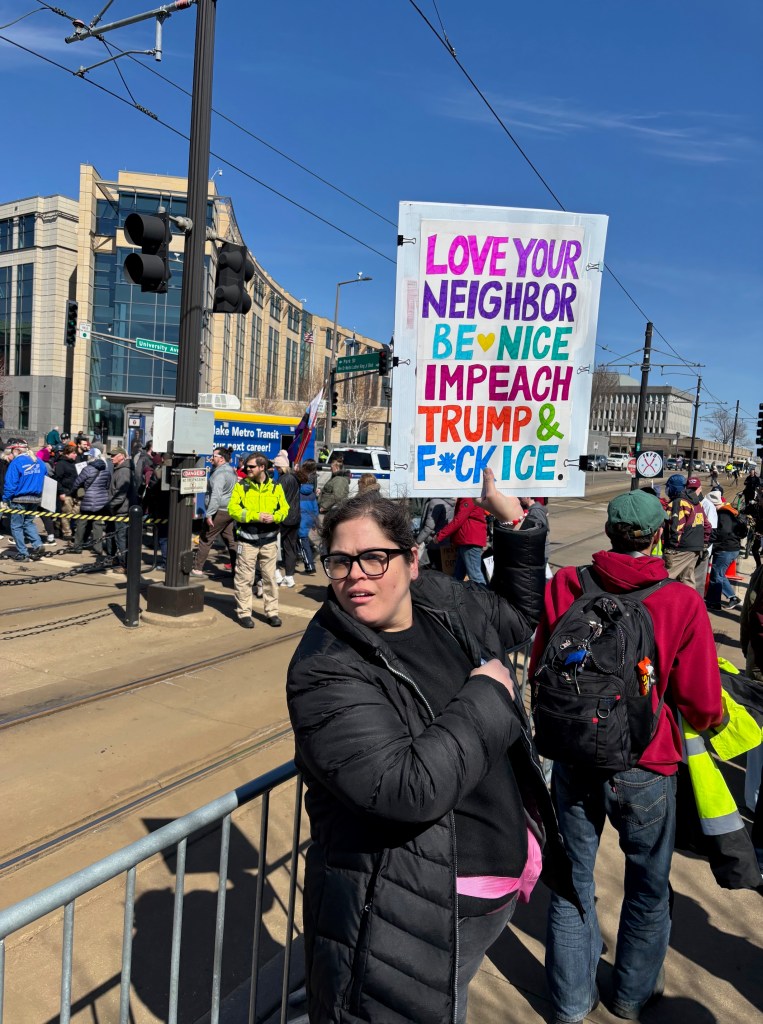
  • I went to the No Kings Protest in Minneapolis today. Wanted to add my body to the mass of people even more concerned than Susan Collins. I don’t know how big the crowd was. For sure big enough to cause traffic tie-ups in downtown for a few hours. Don’t blame me, I took the bus. As to demographics, the assembled were, if my impressions may be trusted, whiter and more female than the general population, and quite a bit older than I would have predicted. At about 67.2 years, I bet I was less than 10 above the median age. Lots of American flags. On the periphery I found a grassy spot to sit alongside some other oldsters who were similarly unwilling to stand in one place for too long. I could tell there were speakers, but not who they were or exactly what they were saying. I guess they got off some zingers because the crowd at intervals erupted in laughter or applause.

    Even if I’d been able to hear the official speakers, the messaging was of course provided mainly by the signs individual attendees had created and now carried. I could see them without difficulty. Some were quite straightforward–for example:

    FUCK YOU TRUMP

    I committed that one to memory. Many of the others I typed into my phone so as not to forget them. There were several variations on

    NO FAUX-KING WAY

    Some people felt a need to explain their presence:

    SO BAD, EVEN THE INTROVERTS ARE HERE

    And:

    I MADE A SIGN OF ALL THE REASONS I’M HERE. COULDN’T LIFT IT.

    One sign had a picture of a full shot glass and off to the side:

    I LIKE MY FREEDOM NEAT. NO I.C.E.

    I think this one had the record for vertical spread:

    SUPER
    CALLOUS
    FRAGILE
    VICIOUS
    RACIST
    SEXIST 
    POTUS

    The absurd underlings were not forgotten:

    YOU COULD GET A BETTER CABINET AT IKEA

    A young woman whose ethnic heritage did not appear to be from the north of Europe had a sign saying,

    IMMIGRANTS BUILT USA, NOW WE HAVE TO REBUILD IT TOO, WTF?

    An elderly white lady held a sign asking:

    HAD ENOUGH OF OLD WHITE MEN YET?

    Ouch. Lots more, but I didn’t spend all my time typing. I’ll close with possibly my favorite:

    ALSO, YOU SUCKED IN HOME ALONE 2


  • As a little kid, I was already a baseball fan, but my team was the Twins, and the National League was almost invisible to me. The Twins never played against Willie Mays, or Hank Aaron, or Bob Gibson, or Roberto Clemente, all of whom except Gibson, who was a rising star, were settled into the back halves of their greatest years. Sandy Koufax I unfortunately knew about, on account of his performance in the 1965 World Series against the Twins. That was when I was 7. Willie Mays hit 52 homers that season, a personal best. Hank Aaron hit 32 homers and 40 doubles. Roberto Clemente batted .329, highest in the National League. The season in which I turned 10 was the one in which Gibson pitched 305 innings with a 1.12 ERA. I can’t recall that any of this made much of an impression on me.

    Now I feel I’m missing out again with Shohei Ohtani. Why isn’t every baseball fan, which would of course include me, raving about him eight days per week? He has to be the greatest player of all time, and not just by a little. Here’s his line in the box score for his team’s pennant-winning, World Series-qualifying win last night against the Brewers:

    At BatsRunsHitsRBIsHRs
    33333

    Why just 3 at bats? He walked once. But wait! Same player had another line in a different section of the box score:

    IPHits RunsEarned RunsWalksStrike Outs
    6200310

    I know, it’s just one game, but it was an important one, and perhaps the greatest single game performance in post-season history. (Don Larsen pitched a perfect game in the World Series but how many homers did he hit that day?) And it’s not as if Ohtani’s output last night was any kind of extreme outlier. For the season, he hit 55 homers, drove in 102 runs, and had an OPS of 1.014. He also pitched 47 innings, striking out 62 batters while compiling an ERA of 2.87 and a WHIP of 1.04. By the way, he had 20 stolen bases. It’s kind of like if Whitey Ford and Mickey Mantle had been the same person.

  • Asked today–unless it was yesterday–about the charming chats of the Young Republicans, Speaker of the House Mike Johnson said that he doesn’t know any of these people, has never even heard of them, but if the details of their jests are true, he condemns them. He said that any picture of him with them was taken at the Inauguration, and he had no idea who they were.

    Not sure this is the top-level defense he thinks it is. They were at the Inauguration? Great! To be fair, “I condemn what they said, if they said it” (they in fact said it, all of it) is marginally better than the vice-president’s “Oh those boys and their edgy jokes!” As has been pointed out, the edgy texts of college-aged critics of Israel can get the authors investigated by the FBI and booted from the country. And some of these Young Republicans are well beyond college-aged. Have you seen their pictures? They tend to confirm my theory that men who are repulsive to heterosexual women comprise a key bloc of Republican voters.

    It’s not surprising that Johnson doesn’t know these losers. His generalized lack of awareness is an evergreen defense. When asked if he was “comfortable” with large cuts to special education services, he said: “I haven’t seen the specifics of that and I don’t know.” Trump said that the Chicago mayor as well as the governor of Illinois should be imprisoned. Asked whether he agrees, Johnson said he “wasn’t following the day-to-day” on that. Cory Mills is a Republican congressman from Florida. His ex-girlfriend just got a restraining order against him after satisfying a judge that the congressman had, among other things, threatened to publish sexually explicit pics he had of her. Asked for comment, Johnson said he had “not heard or looked into the details of that.” When a different reporter noted that this wasn’t the first woman to get a restraining order against Mills, Johnson said: “Let’s talk about things that are really serious.”

    Sort of surprising, therefore, that Johnson knows about Bad Bunny and doesn’t think he should be performing at the Super Bowl.

  • That’s my current reading project in the picture. Pretty good chance I will at some point abort, as it comes in at just over 1250 pages, and has a companion, History of the US During the Administrations of James Madison, which is also about 1250 pages. Someone trained in actuarial science could likely confirm that, at my current rate of progress, there’s a credible chance I wouldn’t finish the work even if I myself never decided to quit.

    If, though, I had a bad diagnosis, I think I’d put down Henry Adams and take up someone else, maybe Elmore Leonard. Not that I’m torturing myself. I read in bed, and a lot of it acts as a soporific, but then there is too, for example, the moment when Thomas Jefferson, obviously a major figure in this immense work, first appears on stage:

    According to the admitted standards of greatness, Jefferson was a great man. After all the deductions on which his enemies might choose to insist, his character could not be denied elevation, versatility, breadth, insight, and delicacy; but neither as a politician nor as a political philosopher did he seem at ease in the atmosphere which surrounded him. As a leader of democracy he appeared singularly out of place. As reserved as President Washington in the face of popular familiarities, he never showed himself in crowds. During the last thirty years of his life he was not seen in a Northern city, even during his Presidency; nor indeed was he seen at all except on horseback, or by his friends and visitors in his own house. With manners apparently popular and informal, he led a life of his own, and allowed few persons to share it. His tastes were for that day excessively refined. His instincts were those of a liberal European nobleman, like the Duc de Liancourt, and he built for himself at Monticello a chateau above contact with man. The rawness of political life was an incessant torture to him, and personal attacks made him keenly unhappy. His true delight was in an intellectual life of science and art. To read, write, speculate in new lines of thought, to keep abreast of the intellect of Europe, and to feed upon Homer and Horace, were pleasures more to his mind than any to be found in public assembly. He had some knowledge of mathematics, and a little acquaintance with classical art; but he fairly revelled in what he believed to be beautiful, and his writings often betrayed subtile feeling for artistic form,–a sure mark of intellectual sensuousness. He shrank from whatever was rough or coarse, and his yearning for sympathy was almost feminine. That such a man should have ventured upon the stormy ocean of politics was surprising, the more because he was no orator, and owed nothing to any magnetic influence of voice or person. Never effective in debate, for seventeen years before his Presidency he had not appeared in a legislative body except in the chair of the Senate. He felt a nervous horror for the contentiousness of such assemblies, and even among his own friends he sometimes abandoned for the moment his strongest convictions rather than support them by an effort of authority.

    One wonders whether the realism of this portrait of an American saint, which only deepens as the narrative proceeds, owes anything to the bitter election of 1800, in which Jefferson prevailed over the author’s great-grandfather, John Adams. But, no, that seems not to be the case, as evidenced by Adams’s brisk dismissal, a few pages later, of the following contemporary “poetic” lines–

    The weary statesman for repose hath fled
    From halls of council to his negro’s shed;
    Where, blest, he woos some black Aspasia’s grace,
    And dreams of freedom in his slave’s embrace.

    –which he calls the invention of a libeller. Not so fast, Henry!

  • When did Republicans last plausibly contend that they were the party of “limited government” and “local control”? I think my parents were alive and voting for them. Now, without a peep of protest from any Republican holding federal office, Trump is sending federal troops into cities that loudly insist they don’t want them. How about letting the locals decide what their problems are, and how to solve them? I believe that used to be the Republican way. It’s hard to imagine a more activist federal government than the one headed by Trump. I suppose it could enact high tariffs, and then give free money to American farmers when their markets disappeared, but that would be too ridiculous to believe.

    I saw a funny, bitter cartoon that I can’t now find but will try to describe. The only figure in the cartoon is Jesus–the robe, the beard, it’s plainly the prince of peace. But he’s wearing a MAGA hat. He’s also carrying a gun, barrel pointed upward at the side of his head as he knocks on a door. The caption says, “Better not be any minorities in there!”

    I wish the effect was gained by means of hyperbole. You know the internet meme comparing “how it started” to “how it’s going”? Well, it’s a little too long, but how about for “how it started” this, from an opinion of Supreme Court Justice Brett Kavanaugh green-lighting the Trump administration’s zest for rounding up brown people:

    The Government sometimes makes brief investigative stops to check the immigration status of those who gather in locations where people are hired for day jobs; who work or appear to work in jobs such as construction, landscaping, agriculture, or car washes that often do not require paperwork and are therefore attractive to illegal immigrants; and who do not speak much if any English. If the officers learn that the individual they stopped is a U.S. citizen or otherwise lawfully in the United States, they promptly let the individual go . . . .

    And, for the “how it’s going,” the lede to an October 6 article in the Chicago Sun Times:

    Pertissue Fisher is still recovering from being detained by federal immigration agents who burst into her South Shore apartment building and pulled her and other residents from their beds early Wednesday morning.

    An agent put a gun in her face, she said. Another placed her in handcuffs tight enough to leave bruises.

    Fisher and other victims of the raid are U.S. citizens, but they were still held for hours.

    Our Declaration of Independence has a section enumerating the crimes of George III against the American colonists. For anyone who thinks “how it started” really ought to reach back a little farther than the daydreams of Brett Kavanaugh, the bill of particulars includes the following three items in succession:

    He has erected a multitude of New Offices, and sent hither swarms of Officers to harrass our people, and eat out their substance.

    He has kept among us, in times of peace, Standing Armies without the Consent of our legislatures.

    He has affected to render the Military independent of and superior to the Civil power.

  • Found myself wondering idly whether Eddie Murray, Oriole star of the ’70s and ’80s, is in the Hall of Fame. What a stupid question. I know now that he’s one of only seven players in the history of the game with more than 3000 hits and more than 500 home runs, so yeah, he’s in the Hall–inducted on his first eligibility, in 2003.

    In my memory, he was a “solid” player–his nickname was “Steady Eddie”–and maybe that tricked me into thinking he was less than amazing, stupendous, superlative. Turns out that being “very good” for around 20 years in a row adds up to “very good plus, plus.” It’s kind of fun to root around on Murray’s page at Baseball Reference, finding new ways to convey his stature. No one in the game drove in more runs in the decade of the 1980s. Being in the 3000/500 club with the likes of Aaron and Mays (but not, for example, Ruth, Gehrig, Williams, DiMaggio, Musial, Mantle) is pretty good. He won three Gold Gloves as a first baseman. I’m just going to set down his home run totals for his first twenty seasons in the big leagues: 27, 27, 25, 32, 22, 32, 33, 29, 31, 17, 30, 28, 20, 26, 19, 16, 27, 17, 21 and 22. I know you could do this for yourself, but I’ll call attention to it: in those first 20 seasons–20 seasons!–he hit 33 homers once, 32 twice, 31 once, 30 once, 29 once, 28 once, 27 three times, 26 once, 25 once, and never fewer than 16. (A couple of these seasons were shortened by player strikes.)

    Never an eye-popping year, and never a bad one, either. Baseball Reference puts a yearly tally in bold print if it led the league, and Murray’s page doesn’t have a lot of that. He never won the MVP Award. He was second twice, and finished in the top ten of the balloting eight times. One statistical oddity: he holds the major league record for sacrifice flies in a career (128).

    Another fun tidbit: he was a high-school teammate of Ozzie Smith, the Cardinals great shortstop. This was in Los Angeles, where Murray was born in 1956. Probably a pretty good high-school team of mainly black kids, assuming they had a pitcher or two who could throw the ball over the plate. Baseball is poorer on account of how African Americans have pretty much stopped playing. I’m one of those who can hardly drive past a ball game in the spring or summer, and I can’t help but notice that the kids playing are almost all white, even though the city is of course racially diverse. The basketball teams aren’t all white! And the quality of the baseball isn’t very high, in my opinion, especially compared to the basketball being played. Pitchers got nothing on the ball, strike everyone out anyway, unless there are four balls before three strikes.