There’s a YouTube channel, “Math with Mr. J,” in which Mr. J presents lessons on common school topics in math. Here’s one I watched the other day, on dividing fractions, a topic that I’ve been working on with my fifth grade friends:
These videos are sometimes used in classroom instruction, and I guess they’re ok: at least, a kid who remembers “keep, switch, flip” will likely answer correctly a fraction division problem on a standardized test, which seems to be the holy grail. (“X percent of students performing at or above grade level!”) But kids will be excused if they get the idea that math is memorizing tricks so that they can then jump through hoops held up by the authors of the Minnesota Comprehensive Assessment. In ethics, you can do the right thing for the wrong reason, in which case you don’t deserve the praise you might receive. In a similar way, you can in math get the right answer without understanding a thing. What’s going on when you divide fractions? Why does the trick work? Some kids might want to know. In what follows I’m warming up for Monday.
What’s going on when you divide fractions isn’t really different from what’s going on in the “easy” problems, like, say, 35 divided by 5. If you write it like this
35/5
you can then simplify the fraction to get the answer, 7/1, or 7. If you pay $35 for 5 widgets, then each widget costs $7. So you get the answer by making the denominator (also known as the divisor) 1. You make the denominator 1 by multiplying it by its reciprocal, and of course you have to do the same thing to the numerator to hold the value steady. The problem then simplifies to multiplying the numerator by the reciprocal of the denominator, since division by 1 changes nothing. A specific case with fractions might be:
Three-fourths divided by two-thirds can be written
3/4 / 2/3,
which equals
3/4 x 3/2 / 2/3 x 3/2.
The denominator now equals 1. Since division by 1 doesn’t change anything, the answer is in the numerator, and the numerator is the product of the amount being divided (3/4) and the divisor (2/3) “flipped” (3/2). This is why “keep, switch, flip” works. It’s math, not magic.
To be fair, Mr. J does in a different video show what’s happening when one fraction is divided by another:
Fine, but I think kids might be less confused if you carve up distance instead of area and ask them, “How many times does this fit into that?” For example, if you’re going on a trip of 35 units, and you divide it up into segments that are 5 units long, how many segments are there? (Seven, because “five fits into 35 seven times.”) Of course, things don’t always work out so neatly. If the trip is 37 units, and you divide it into segments that are five units long, how many segments are there? (“How many times does five fit into 37?”) The question doesn’t change when we’re dealing with fractions. If you’re going on a trip of three-fourths of a unit, and you divide it up into half-unit segments, how many segments are there? (“How many times does a half fit into three-fourths?”) We can visualize the answers to all these questions with number lines:
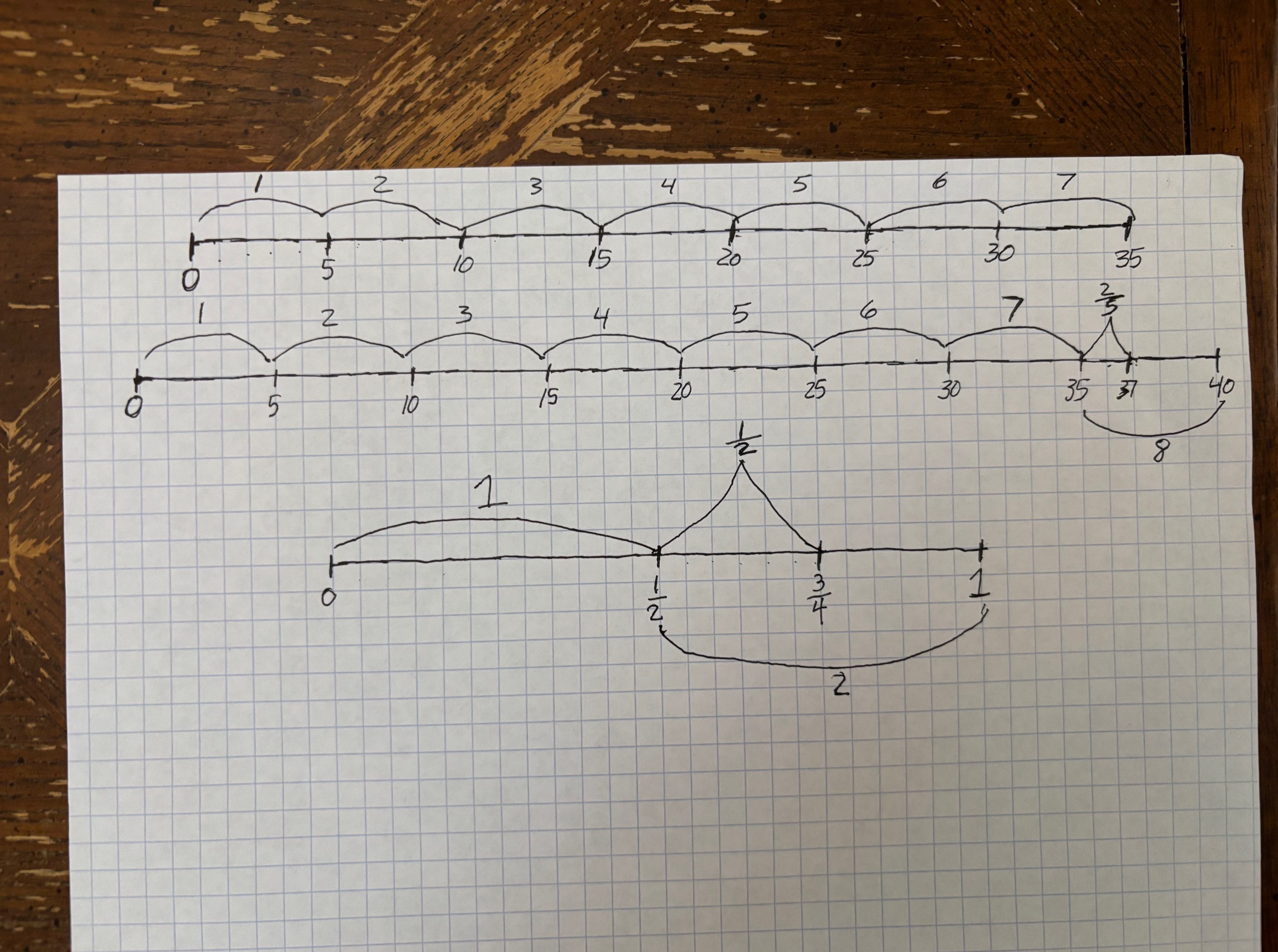
Five fits into 35 seven times, so 35 divided by 5 is 7. Five fits into 37 seven times plus two-fifths of what would be an eighth time, so 37 divided by 5 is 7.4 (“seven and two-fifths”). A half fits into three-fourths one time plus half of what would be a second time, so 3/4 divided by 1/2 equals 1.5 (“one and a half”).
 Eric the Blue
Leave a comment