Ah, made it to winter break, which means this year that I get a reprieve from overhearing 10-year-olds talk among themselves about ICE. Attendance is down and it’s not all the flu. People are lying low. Our weekly newsletter implores parents to keep sending their kids to school, and to contact the office with concerns–we will connect them to organizations that can help or, at least, advise. We have close to 600 kids enrolled and about half of them speak Spanish at home. By the law of large numbers, it seems certain that there are cases of the potentially heart-breaker scenario: kids natural born citizens of the US, at least one parent undocumented.
Lying in bed this morning, I heard Ayesha Rascoe, of NPR, interview Seth Lavin, an elementary school principal in Chicago.
Rascoe: Can you start by just telling us what you have been seeing and hearing in the classrooms at your elementary school?
Lavin: Sure. At my school and really schools all across the city, you see this tremendous and terrifying impact on children and families. Kids know. They feel it. They see it. They see the fear in their parents. They see the fear in their classmates. A third grade boy–an 8-year-old–at school, his teacher said he wasn’t eating. He said, well, I don’t want to punch in my lunch code. You know that’s the system here. You put in the number and get your lunch. He said, I don’t want to put in my code. I don’t want ICE to know where I am or to know where my family is. And so this third grader, in his 8-year-old brain, he had this misconception that his lunch code was going to show people where he was, put him at risk, put his family at risk. And so he was sitting at school not eating.
Rascoe: Well, what do you do in a situation like that? How does a school handle that sort of situation and that sort of fear from their students?
Lavin: That’s a really good and really difficult question, and it’s a question that our teachers ask. . . . There are kids who don’t want to come to school because they’re scared that if they come to school, something’s going to happen to their parents while they’re with us and that when they get out at the end of the day, there’s going to be nobody to pick them up and they won’t have been able to say goodbye. You can’t say that it’s all right, it’s going to be fine, because that isn’t all right. . . .
Rascoe: Were any students or families of your students at your school detained by ICE?
Lavin: You know, I want to be a little bit careful about specific situations or cases. I don’t want to draw attention to anything specifically. But there’s 600 schools in Chicago and more than 4000 people detained. And so yes. There have been impacts at my school, and at every school that I know, there have been kids who are living in this fear, and at many, many, many schools, this is a reality. Kids crying in a classroom, kids crying in the cafeteria. [We ask] what’s wrong. What’s wrong is that they took my dad. What’s wrong is that they took my mom. . . .
Rascoe: As a principal, obviously, there’s always politics involved in schools. At your school, there may be parents of students who maybe support what President Trump is doing. Maybe–I don’t know if you’ve heard from anyone who’s saying, look, he’s enforcing the law, fulfilling his mandate. What would you say to those parents?
Lavin: One of the things that was so shocking about this blitz in Chicago, about the way that it happened, I mean, trucks speeding down the street, people wearing masks and unmarked uniforms breaking car windows with batons and throwing tear gas–even people who say, I’m worried about the border or I’m worried about the distribution of resources, I don’t know anybody who looked at that, who saw that with their eyes and said, This is a good thing.
And I think sometimes people have this imagining that an immigration blitz is going to get somebody that they should be scared of or is somehow justice-oriented. But when it’s the mom of the kid in your class that you’ve seen every day for the last 10 years who’s just trying to have a good life, walking her kids to school–not because she’s trying to take, but because she’s trying to build something–when it’s that person who’s terrified, when it’s the kid in your kid’s class who doesn’t come to school because their parents are afraid to leave home, and when you’re seeing on the news tear gas in the street that you drive down every day to get to the store, nobody supports that.
Rascoe: That’s Seth Lavin. He’s a public school principal in Chicago. Thank you so much for joining us.
Lavin: Thank you.
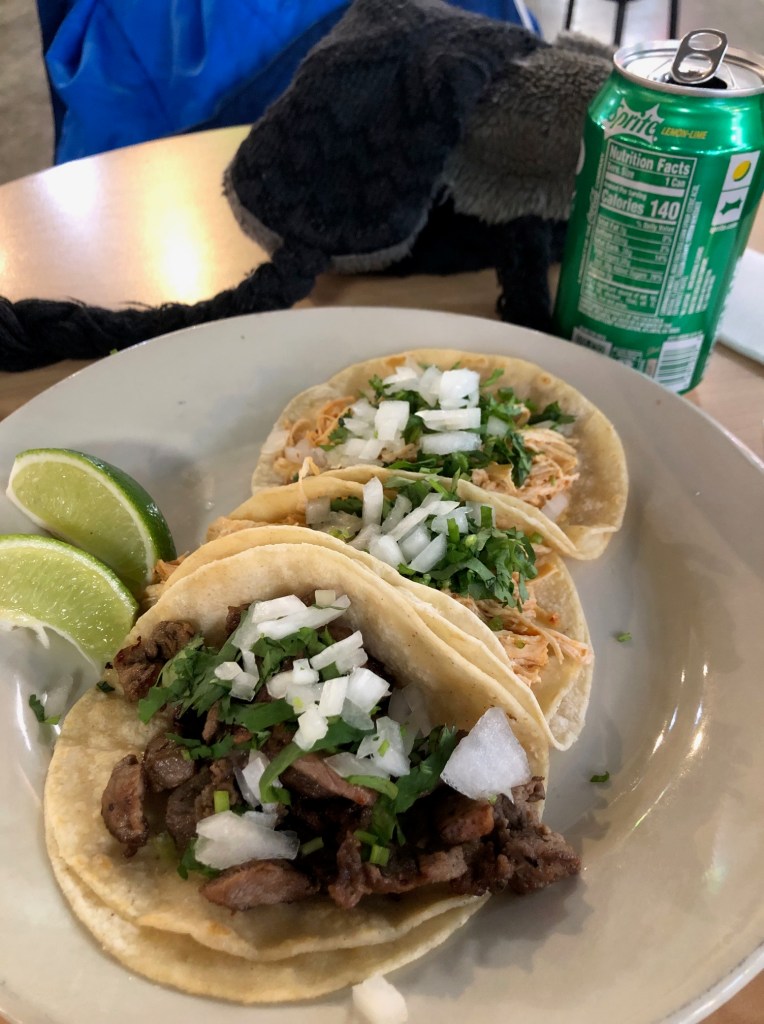
So … winter break reprieve incomplete, news continues to happen. I’ve heard that immigrant businesses in the Lake Street corridor here in south Minneapolis have been suffering–sales down, foot traffic down. I therefore made a big sacrifice and had tacos for supper last night at Los Ocampo in the Midtown Exchange Market. Three tacos (pic below)–two chicken, one steak–cost less than eleven dollars, and were delicious. Then I wandered around buying desserts and beers at different spots. Lots of the stores display signs:
TODOS SON BIENVENIDOS MENOS ICE
ICE NO ES BIENVENIDO AQUI
LATINA MINNESOTANS KNOW ICE IS DANGEROUS & SLIPPERY, ALWAYS DE-ICE
 Eric the Blue
Leave a comment